

There are eleven bottles on the shelf at my grocery store with the word magnesium on the front, and the word printed right underneath it is the one that decides what you are holding. Glycinate. Citrate. Oxide. Malate. Magnesium is the easy part. It is the second word that changes the purchase, and it is always set in a smaller size, as though the bottle assumes you already know the difference.
I am 63. I retired from a middle school library three years ago, I live in Dayton, Ohio, and I read labels the way I used to read a reference book: slowly, with my reading glasses on and a pencil in my hand. The bottle I will use as the example for the rest of this piece is Doctor's BEST High Absorption Magnesium Glycinate, which has been in my kitchen cabinet for two years. What follows is the five step read I do on a magnesium label before the bottle goes on the shelf. It is not advice about what you should take. That belongs to you and your own doctor or pharmacist, and it matters most if you take a prescription, are pregnant, or have a health condition.
The bottle that answered the second word question for me
Doctor's BEST High Absorption Magnesium Glycinate comes in a 240 tablet bottle. The label states 100 mg per tablet and 200 mg per serving of two tablets, and it states elemental magnesium per serving, which is the line I look for first. It is a tablet, unflavored, vegan, non-GMO, gluten free and soy free. Mine sits with dinner.
Amazon Check Today's Price on Amazon →Five Steps I Use on Every Magnesium Label
Step 1: Find the Word After Magnesium
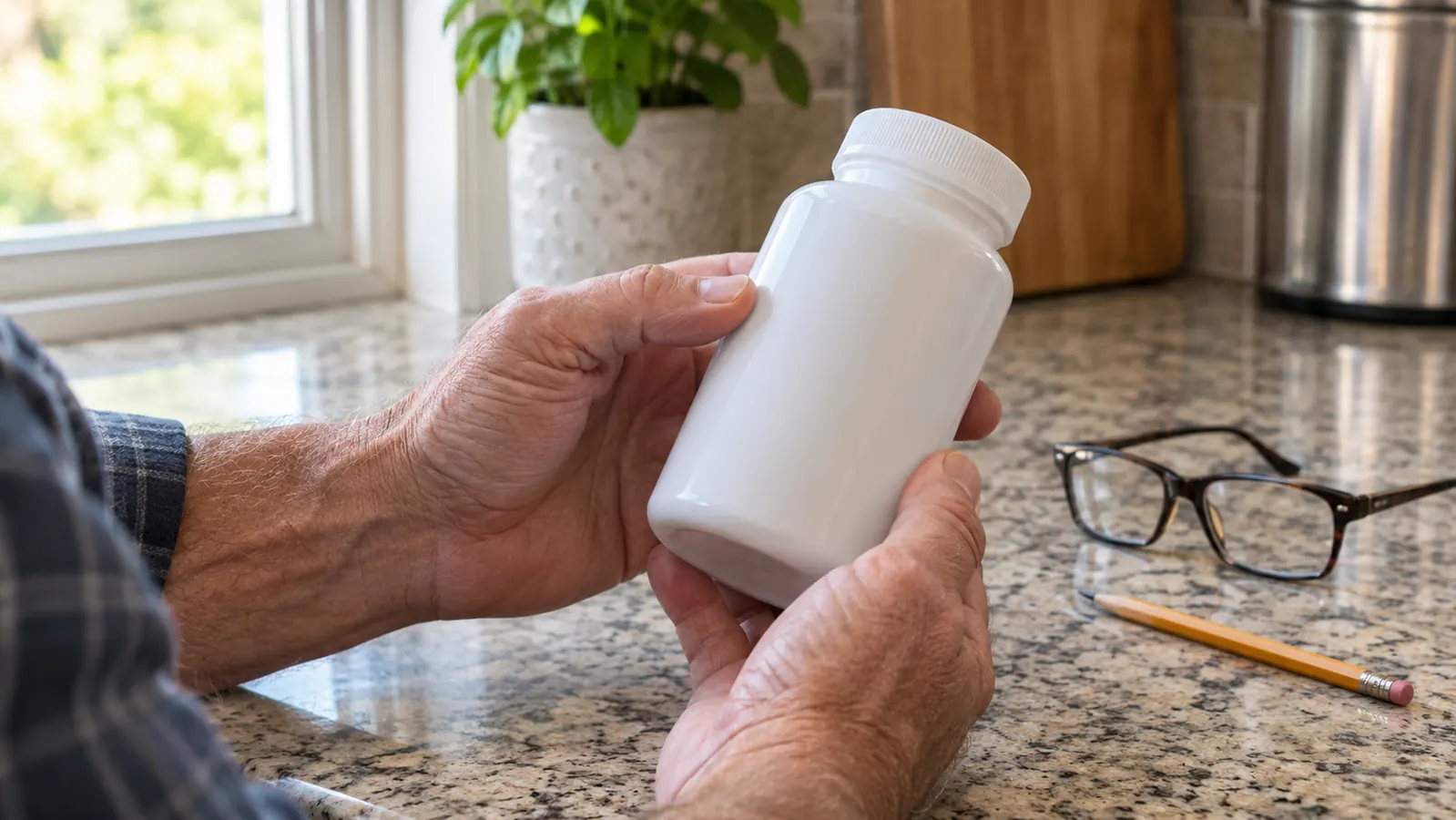
Turn the bottle around before you do anything else with it. The front panel gives you two words. The first is magnesium. The second is the form, and the form is what separates one bottle from every other bottle on the same shelf. Two bottles can both say 200 mg on the front and be entirely different purchases. When I am standing in the aisle with my glasses on, the second word is the only thing I am looking for.
For two years I did not do this. I would read magnesium, put the bottle in the basket, and go home. Then I started keeping the index card, and the card forced the issue, because a card that says magnesium and nothing else cannot tell two bottles apart six months later. Now the second word goes onto the card in pencil, right after the brand, and I have crossed one out before and written a different word above it.
The word on this label is Glycinate. It is printed on the front under the magnesium, and it is the reason the bottle is named what it is named. I do not need to know the chemistry to use the word. I need to be able to say it, write it, and read it back to my doctor at my yearly physical, which is exactly what the card is for.
Step 2: Read the Serving Size Before the Milligrams
A number with no serving size attached is a number you cannot use. This bottle says 200 mg per serving, and four words later it says a serving is two tablets. That means one tablet is 100 mg, and it means the big number on the front describes two tablets, not one. It is the easiest misread on the bottle, and I made it myself more than once before the pencil habit started.
So the serving line comes second, before I look at anything else. Serving size, then milligrams, in that order, on every bottle in my cabinet. The multivitamin is one tablet. The vitamin C is one capsule. The magnesium is two tablets, and it is the only bottle in the cabinet where the serving and the tablet are not the same number, which is exactly why it is the one I check twice.
Two tablets at dinner is what my card says, and the bottle is built around a serving of two, so the arithmetic is already done for me. A bottle of 240 tablets lasts me about four months at that pace. How long a bottle lasts is one of the few things about a supplement I can measure honestly, and it belongs in the same pencil note as the second word.
Step 3: Check What the Milligrams Are Counting
This is the part that separates a careful read from a quick one. Magnesium on a label is attached to something else, and the number can describe the whole compound or just the mineral. Two bottles can both print 200 mg and mean two different amounts. The phrase to hunt for is elemental magnesium, and it is usually set smaller than everything around it, or tucked onto the supplement facts panel rather than the front.
This label states elemental magnesium per serving, and it states it plainly enough that I did not have to do arithmetic on the back of my hand in the aisle. I wrote elemental on the card. I also wrote that the tablets are large, because they are, and two at once is the tradeoff I accepted for a bottle I open once a day and then close.
The rest of the panel is short, and short is something I can actually judge. 100 percent chelated, which is the maker's description of their own product. Vegan. Non-GMO. Gluten free. Soy free. Unflavored. The listing also says up to six times better absorption, and that is Doctor's BEST talking about Doctor's BEST. I cannot check that with a pencil, so I note it and move on to the things I can check: the tablet count, the serving, and the size of the tablet in my hand.
Step 4: Read the Asterisk and the Words That Sound Like Promises
The front of a supplement bottle is the marketing. The back is the part that has to follow rules. Look for the asterisk, then find what it points to. On a bottle like this one it points to a sentence saying the statement has not been evaluated by the Food and Drug Administration, which is the sentence that tells you the front panel is not a medical promise and never was. That sentence is not fine print. It is the most honest sentence on the label.
The benefits line on the listing for this bottle names a body system, and the asterisk applies to that line too. I am not going to repeat it as though it were something I know to be true of me. I read it, I noted the asterisk, and I turned the bottle around and went to the directions and the other ingredients line, which are the parts I can actually use in a kitchen.
What I can judge is how much of a label is plain fact and how much of it is mood. A short ingredient list, a stated serving, a stated tablet count and a clear direction line are facts. Words like high absorption are the maker's claim. I write the facts on the card and I leave the mood in the aisle.
Step 5: Write It on One Card and Take the Card to Your Doctor
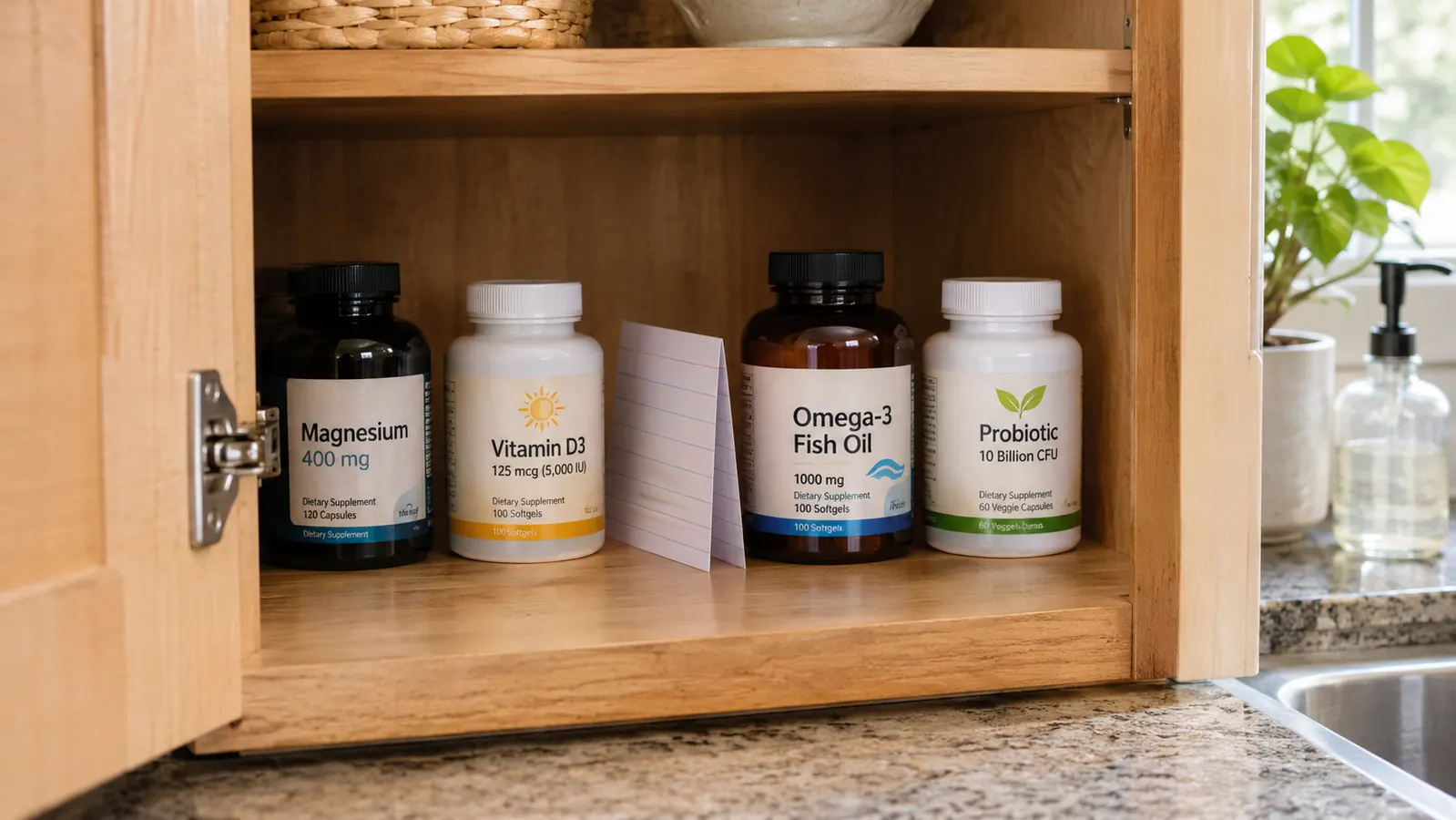
I keep one index card in the cabinet next to the bottles, and I write what I take on it in pencil, in the same order every time. It is not a health record. It is a memory aid, and it is the reason I can answer a question at my yearly physical without guessing or going quiet for a minute. Five lines fit on one card if you write small, and a card that fits in a pocket is a card you will actually carry.
The magnesium goes into the PM lid of a blue plastic seven day pill box, the one with the AM and PM lids, which I fill every Sunday evening at the kitchen table. It sits with dinner, around six. The pharmacist at my grocery store suggested keeping the magnesium away from the multivitamin with iron, so the two never share a lid. That was his suggestion, and I wrote it on the card so I would not have to remember it on a Sunday.
At my yearly physical I hand the card to my doctor. She has seen all five things on it, including this bottle, and she knows what is on the card because she has read it, not because I recited it from memory. If you do not have a card yet, that is the step I would do first, before the other four. A label you cannot explain to your own doctor is a label you have not finished reading.
I cannot tell you I feel a difference from any one bottle, and I would not trust anyone who says they can. What I can tell you is what the label says, how big the tablet is, and whether I still open the bottle at six o'clock without thinking about it.
What Else Helps
A pencil beats a phone for this. A phone wants to look things up, and looking things up in an aisle leads to reviews, and reviews lead to somebody else's routine and somebody else's bottle. A pencil only writes what the bottle in front of me actually says. It also lets me cross things out, which is how a card stays honest after two years of Sundays.
Good light and my reading glasses. The serving line is small on every bottle I own, and the temptation to squint and guess is real. I read the back panel at the kitchen table, under the lamp, before the bottle goes into the cabinet. If I cannot read it there, I do not buy it in the aisle. That rule has saved me from more than one bottle with a second word I could not make out in the store.
The pharmacist at my grocery store, a man who has answered the same question for me more than once without sighing. He is free, he is standing right there, and he knows things about prescriptions that the back of a bottle does not cover. My doctor is the other call, and for anything involving a prescription, a pregnancy or a health condition, she is the first call rather than the second. Ask yours before anything goes onto a card.
And one new bottle at a time. The five things in my cabinet arrived over three years, not in one trip. One at a time is how the card stays readable, and it is how you know which line you would be changing if you changed anything. A cabinet full of new bottles is a card with no story on it.
Two tablets, one serving, one line on the card
If the label reading is done and the arithmetic is the part you wanted checked, this is the bottle I use: Doctor's BEST High Absorption Magnesium Glycinate, 240 tablets, 100 mg per tablet, 200 mg per serving of two, taken with dinner. Ask your own doctor or pharmacist before it goes on your card.
Amazon Check Today's Price on Amazon →