

Two years ago I stood in the vitamin aisle of my grocery store with a pencil in one hand and a scrap of paper in the other, trying to decide whether magnesium deserved a place in my cabinet. I am 63. I retired three years ago after 31 years as a middle school librarian in Dayton, Ohio, and I read a label the way I used to read a reference book: slowly, sometimes out loud, and always with something to write on. That week I bought Doctor's BEST High Absorption Magnesium Glycinate. It has been on the shelf behind my cabinet door ever since.
Here is the part most reviews leave out. I cannot tell you I feel a difference from any one bottle, and I would not trust anyone who says they can. What I can judge is the label, the size of the tablet, the smell when the cap comes off, the room the bottle takes up in the cabinet, and whether a person with reading glasses and a seven day pill box is still keeping up with it in month four. That is what this is. Nothing more, and I hope nothing less.
The Quick Verdict
A plain, readable label on a tablet that is bigger than I would like. Two years in, the bottle still earns its shelf space, mostly because nothing about it makes me guess.
Amazon Check Today's Price →The magnesium that has stayed on my index card for two years
240 tablets, 200 mg per serving of two. Read the serving size against your own list before you buy, and ask your pharmacist where it fits in your day.
Amazon Check Today's Price on Amazon →How I've Used It
I bought the first bottle 24 months ago, and I bought it the careful way. Before I opened it I took the label and my index card to my yearly physical and asked my doctor about it. She has been my doctor for years. She looked at the card and said magnesium was fine for me. That is the only reason the bottle is in my house. I am not a doctor and I am not going to sound like one on paper, so everything below is about the bottle, the tablet and the routine, and nothing else.
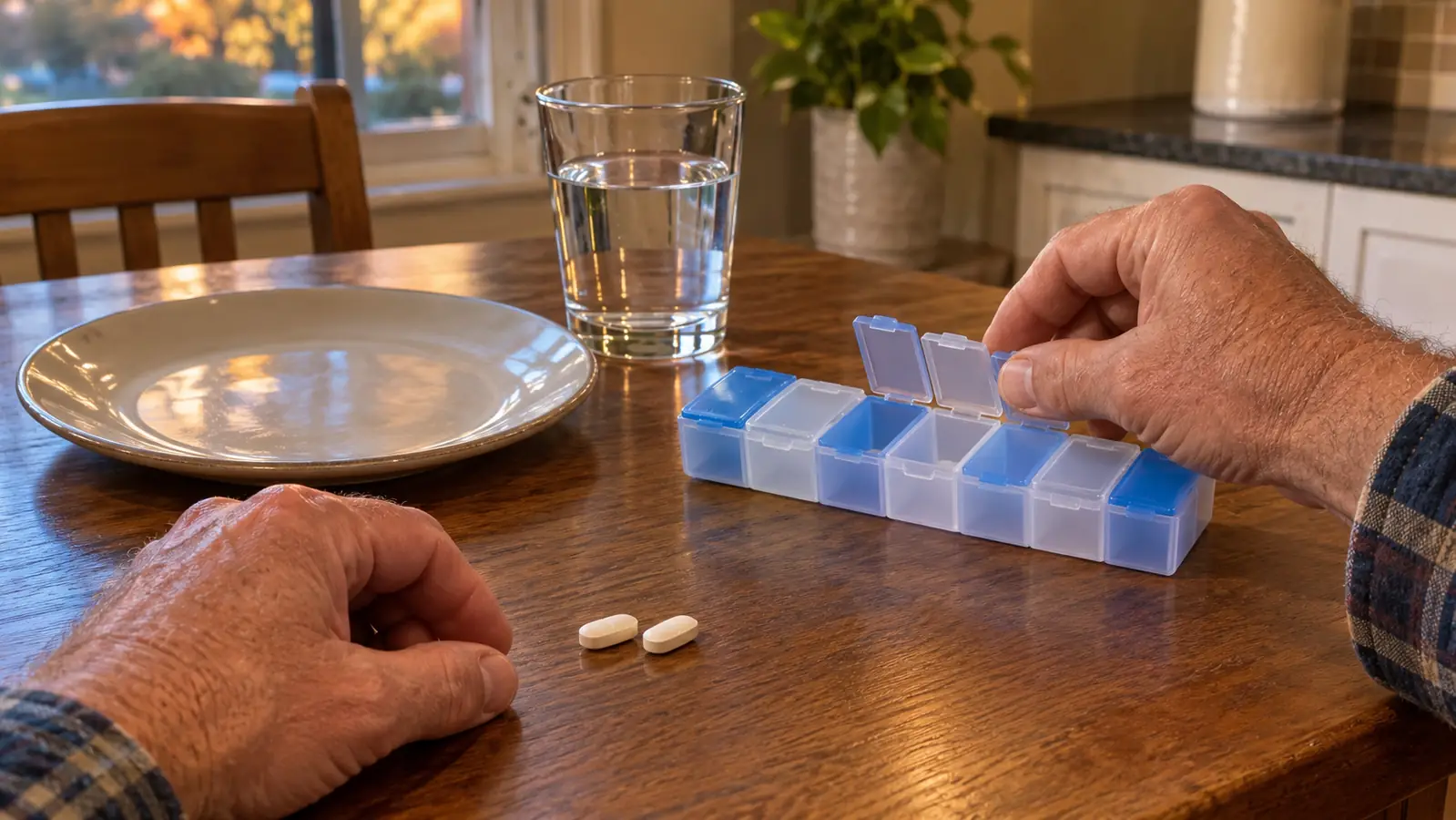
I take two tablets with dinner, around six o'clock, with food and a glass of water. Two tablets is one serving according to the label, and one serving is all I take in a day. The magnesium lives in the PM lid of my blue seven day pill box, which I fill on Sunday evening at the kitchen table. It is the only thing in that lid. Breakfast has its own collection and its own lid, and the two never meet. That sounds fussy when I write it out. It takes about four minutes a week.
That separation is deliberate. The pharmacist at my grocery store, a man who has answered a great many of my questions without ever once making me feel foolish, suggested I keep the magnesium away from my multivitamin, which has iron in it. So the magnesium goes with dinner and the rest goes with breakfast. I have done it that way for two years, and it has never once been the hard part of my day.
The first Sunday I filled that box, I sat at the table with the bottle in front of me and the index card beside it, and I counted fourteen tablets into the PM lids before I trusted my own arithmetic. Fourteen felt like a great many to lay out at once on a table meant for one person. Then I wrote the line on the card, two tablets with dinner, along with the date I started, and I have written that same line every time since, which is six times now. Counting them out took longer than the rest of the box put together, and I have never once minded doing it.
What the Label Actually Says
The bottle holds 240 tablets. The serving size is two tablets, and the label puts the magnesium at 200 mg per serving, which works out to 100 mg per tablet. What I like, and I know this sounds like a small thing to like, is that the label uses the word elemental. That tells me the number refers to the magnesium itself and not to the weight of whatever it is attached to. Plenty of bottles are vague about that. This one is not, and I noticed.
The rest of the label is plain in the way I want a label to be plain. It is a tablet, unflavored, vegan, gluten free and soy free. The Doctor's BEST listing says the mineral is 100 percent chelated, and that it is not buffered with fillers or additives. The listing also says it takes the most direct route into your system, for up to six times better absorption. That is the maker's sentence, not mine. I cannot check absorption from a kitchen table in Ohio, and neither can anyone else reading a bottle. I can tell you the claim is printed there and that I read it with a pencil in my hand.
The company says it has been at this for over 35 years. I note that the way I used to note a publisher's imprint on a book. It tells you who made the thing. It does not tell you whether the thing is any good. What tells me that is the bottle in my hand and the four months it takes to empty it.
When the card got full last winter, I did not start over. I copied the old lines onto a fresh card exactly as they stood, because a card my doctor has already read is worth more than a tidier card. Copying it meant reading the bottle once more from the top, and that is how I noticed the serving size sits above the number rather than below it, where my eye goes first. A small thing. Small things are the whole difference between a label you can read standing up and one you have to sit down with, and this one I can read standing up.
The Tablet Problem, Which Is Real
The tablets are big. I am not going to dress that up. Two at dinner is the part of this bottle I would change if I could, and I have said so out loud at my own kitchen table more than once. If swallowing a large tablet is difficult for you, that single detail should decide the question, ahead of anything printed on the front of the bottle.
I have a habit for it, which is not the same as a solution. I take them one at a time, with water, in the middle of the meal rather than at the end, so the food does the work of helping me not notice. That is my own habit and it is not advice. If pills are a struggle for you, that is a question for your pharmacist, not for a retired librarian with a pencil.
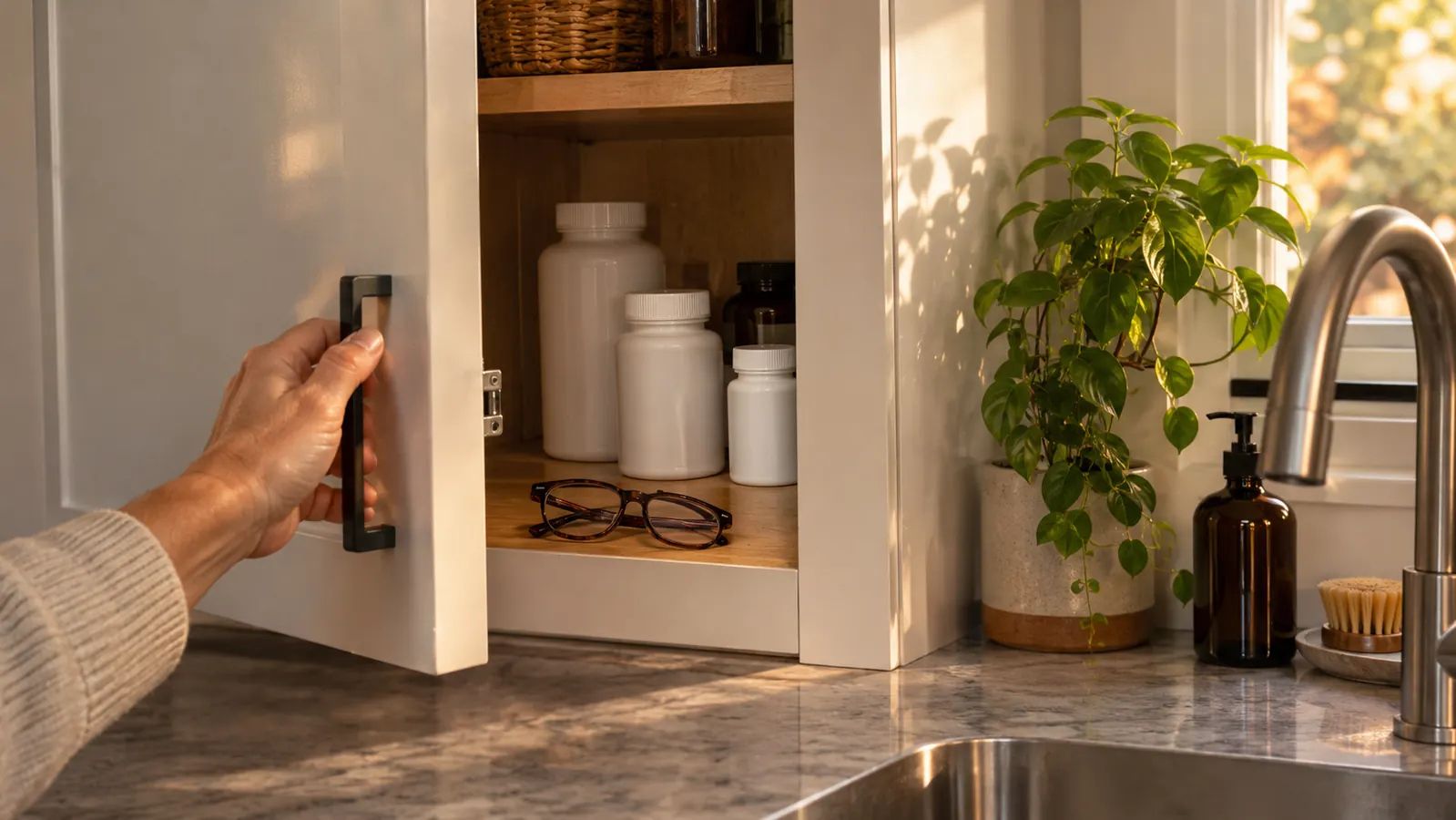
The bottle is a little over five inches tall, 5.19 inches according to the listing, and about three inches across. It sits on the shelf in the cabinet to the left of my sink, where all five of my bottles live behind a closed door, away from the stove. It is not a small bottle and these are not small tablets, and pretending otherwise would be the kind of review I used to throw across the room.
How It Fits an Ordinary Day
On Sunday evening I sit at the kitchen table with the pill box and the bottles and I fill the whole week. The magnesium takes the PM lids. That is fourteen tablets for seven nights, and I count them out because counting is what I do. Then the index card goes back in the cabinet with what I take and when I take it. I took that card to my yearly physical, and my doctor has seen every item on it. That is the only reason I am comfortable writing any of this down.
During the week there is nothing to think about. Dinner is at six. The pill box is on the counter by then. Two tablets come out of the PM lid and go down with the meal. On the nights I eat out, which is not often, the pill box goes in my bag. It has never been the thing I forget. The multivitamin at breakfast is the one that takes more attention, and the one I notice.
Take a Tuesday in February, the sort of evening when dinner is soup and toast and nothing about it looks like a routine worth writing down. Six o'clock, the pill box on the counter, two tablets out of the PM lid, a glass of water. The whole thing takes as long as carrying my bowl to the table. That is the test I apply to everything in that cabinet now: does it survive a Tuesday in February, when nobody is watching and there is nothing to be proud of? This bottle has survived two of them.
A bottle lasts me about four months. Two years in, that is six bottles and no gaps, and not one bottle I had to throw away. There is something to be said for a product that does not ask you to rearrange your day around it. This one asks for two tablets at a meal I was going to eat anyway. For a person who has decided to take something daily, that is most of the battle.
What I Compared It To
I have never taken magnesium citrate. I want to be exact about that, because it is easy to write a comparison as though you lived it. What I did was stand in the aisle with both labels in my hands and read them, and then ask the pharmacist at my grocery store which one he would put on his own shelf. He said people's stomachs differ and he would not choose for me. I believed him.
I read the citrate label twice, once for the number and once for the serving size, and wrote both on my scrap of paper with the pencil. Then I read the glycinate label the same way. What slowed me down was not the milligrams, which sat close enough together that I had to check which belonged to which bottle, but the words around them. On the Doctor's BEST label the word elemental did the explaining for me. On the other bottle I could not find the same help at a glance, and I may simply have been standing under a poor light with my glasses halfway down my nose.
I stayed with the Doctor's BEST bottle for a boring reason. It was the one my doctor had already seen on my index card. Changing would have meant another conversation, another line on the card, and a fresh four months of finding out how a different tablet sat at dinner. I am 63 and I have decided that boring is a feature.
If you are choosing between the two, read both labels the way I did, and then ask someone who knows your prescriptions. That is the whole of my advice on it. My choice is not a verdict on the other bottle. It is a verdict on my own shelf.
What I Liked
- The label says elemental magnesium, so the 200 mg per serving is the mineral itself.
- 240 tablets at two a day runs about four months, long enough to stop thinking about it.
- One serving a day, at a meal I already eat, so it fits the PM lid without rearranging anything.
- Vegan, gluten free, soy free and unflavored.
- The serving size, the number and the ingredient list are all readable without a magnifying glass.
Where It Falls Short
- The tablets are large, and the serving is two of them.
- High absorption and the six times figure are the maker's words and cannot be checked from the bottle.
- The bottle is 5.19 inches tall and takes real shelf space in a small cabinet.
- If your doctor ever changes the amount, a 240 count bottle is a long commitment.
What I can judge is the label, the tablet, the bottle, and whether I am still keeping up with it in month four. That is the review.
Who This Is For
This is for someone who has already asked their doctor whether magnesium is fine for them, and got a yes. It is for a person who wants the number on the label to be the mineral itself, who does not mind two tablets at dinner, and who would rather have a plain bottle than a clever one. If you fill a pill box on a Sunday and like a routine that stays put, this slots into it without any fuss.
It is also for the person who reads the back of the bottle in the store and wants to be able to finish. There are labels that take a magnifying glass and a second cup of coffee. This one has a serving size, a number, and a short list, and I could read it standing up in the aisle. For a woman with reading glasses in her purse, that counts for something.
Who Should Skip It
Skip it if a large tablet is hard for you, because there is no way around that here. Skip it if you have not asked your doctor, especially if you take a prescription, are pregnant, or have a health condition. Skip it if you want a powder or a chewable, since this is a tablet and only a tablet.
And skip any bottle at all, this one included, if you are hoping to feel it working. I have taken two tablets with dinner for two years and I cannot tell you that I do. What I can tell you is that the label is honest, the bottle lasts about four months, and the routine has never once been the reason I had a bad evening. If that is not enough for you, save your money and ask your doctor what would be.
Two years, six bottles, one shelf in the cabinet
If your doctor has already said magnesium is fine for you, this is the bottle that has stayed on my index card. Check the serving size against your own list, read the label with your own pencil, and ask your pharmacist before you add anything new.
Amazon Check Today's Price on Amazon →