
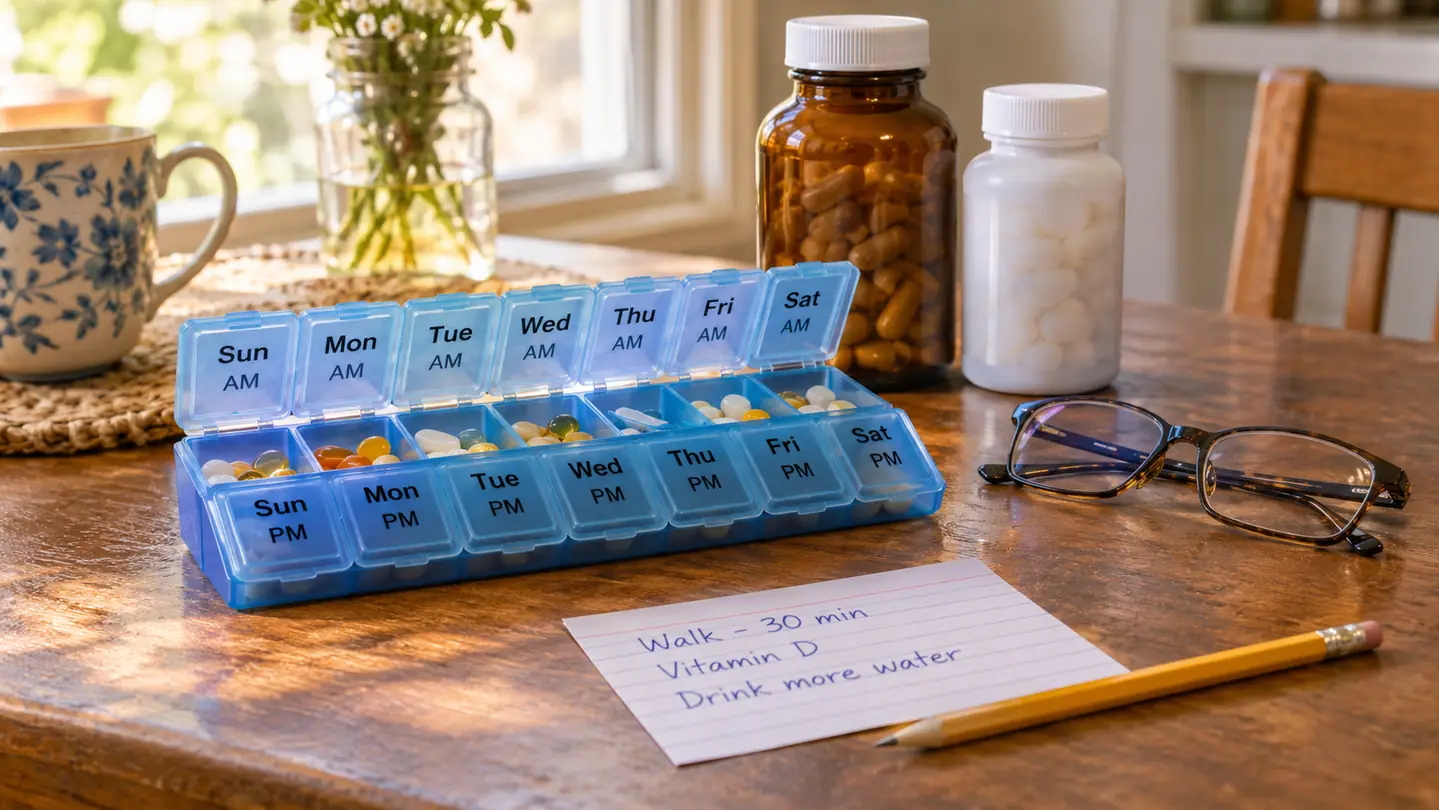
Two bottles of magnesium sat shoulder to shoulder on the shelf at my grocery store, and I stood there long enough that a stock clerk asked if he could help me find something. One was Doctor's BEST High Absorption Magnesium Glycinate, the 240 tablet bottle that has lived in the cabinet left of my sink for the past two years. The other was magnesium citrate, a form I had read about on labels and never once brought home. I am not a doctor and I am not going to pretend to be one. I am a retired librarian with reading glasses, a pencil and an index card, and this is what I can honestly tell you about the two.
Here is the short answer, because a short answer is what I want when I am standing in an aisle. For my routine, the glycinate is the bottle that stayed. I take 2 tablets with dinner, once a day, and a bottle lasts me about 4 months. It is the form my doctor has already seen written on the index card I keep in the cabinet, and my pharmacist had no reason to change it. That is the whole case, and it is a case about convenience, not about anything I could feel. Magnesium citrate is not a mistake and not a lesser thing. It is a different bottle, and if your own doctor or pharmacist names citrate to you, then citrate is the one to buy. Ask them before you ask me, especially if you take a prescription, are pregnant, or live with a health condition.
| Doctor's BEST Magnesium Glycinate | Magnesium Citrate | |
|---|---|---|
| Form on my card | Tablet, 100 mg per tablet, 200 mg for the 2 tablet serving | A different magnesium form sold under the same mineral name |
| Tablets at one sitting | 2, with dinner | Set by whichever bottle you buy; I did not buy one |
| Taking half a serving | Yes, one tablet is half the serving | Depends on the bottle in your hand |
| Room in the cabinet | 3.13 x 3.13 x 5.19 inches, stands beside the multivitamin | I never brought one home to measure |
| The maker's wording I cannot check | High absorption is the maker's phrase, and the label does state elemental magnesium per serving | Every bottle in that aisle makes its own version of the same claim |
| What my pharmacist said | It was already on my card and he saw no reason to change it | He said people's stomachs differ, which is a reason to ask, not a reason to switch |
| If your own doctor names citrate | Then this is not your bottle | Then citrate is the one to buy |
| Best for | A routine that is already running, with a form your doctor has seen | A person whose doctor or pharmacist has named citrate |
How I Ended Up With One Bottle and Not the Other
I bought the Doctor's BEST bottle 24 months ago, the week after a yearly physical. I had asked my doctor about magnesium, she said it was fine for me, and I wrote it on the index card that lives in the cabinet, in pencil, that same evening. That is the entire permission slip. Two tablets with dinner, once a day, nothing else. A bottle of 240 lasts me about 4 months, and I have rebought the same one every time since without standing in the aisle for very long.
The citrate I met later, on a Tuesday, with a list in my hand and time to spare. I picked up two of the citrate bottles and read them the way I used to read a reference book, front to back, then back to the front again to check what I thought I had read. Then I asked the pharmacist at my grocery store what he thought. He said something I have repeated ever since: people's stomachs differ. He did not tell me to switch. He did not tell me one was better. He told me to ask, which is the most useful thing anyone behind a pharmacy counter has said to me in a grocery store.
So I put the citrate back on the shelf. Not because I had read something alarming, and not because anyone warned me off it. I put it back because the glycinate was already on my card, my doctor had seen it there, and starting a second bottle to find out whether I liked it better struck me as a reliable way to end up with two open bottles and no answers.
The bottle that fits your routine is not the one with the best words on it. It is the one your doctor has already seen written on your card.

Where Doctor's BEST Wins
It asks one thing of me, and only one. Two tablets, with dinner, at about 6 in the evening. I fill the PM lid of my blue pill box on Sunday night at the kitchen table, the magnesium goes in with the rest of the week, and I do not think about it again until I open that lid. My pharmacist suggested keeping it away from the multivitamin with iron, so the magnesium rides in the PM lid and the multivitamin rides in the AM lid, and they never meet. A bottle with a fussier serving would have broken that habit inside a month.
The label also does the arithmetic for me. It counts elemental magnesium per serving and says so plainly, 100 mg per tablet and 200 mg for the 2 tablet serving. That means one tablet is exactly half a serving, so if my doctor ever wants to talk about a different amount, I am not guessing or breaking a tablet in half with a butter knife. I like a bottle that lets me do simple arithmetic without a calculator, and I wrote both numbers on the index card with the pencil so I would not have to trust my memory.
Then there is the shelf life of the thing, which nobody mentions and everybody lives with. 240 tablets at 2 a night is about 4 months of a habit, which is long enough that I am not reordering constantly and short enough that I am not committing to a bottle the size of a coffee can. The bottle measures 3.13 by 3.13 by 5.19 inches, so it stands next to the multivitamin without shoving anything aside. The listing says the tablets are 100 percent chelated and not buffered with fillers or additives, and that the product is vegan, non-GMO and gluten-free. Those are the maker's words and I am repeating them as words. What I can tell you is that the listing carries a 4.6 star average across more than 77,000 ratings, which means the bottle arrives and people keep buying it, and nothing more than that.
Where Magnesium Citrate Wins
It wins the only argument that matters if your situation is not mine. If your doctor or your pharmacist names magnesium citrate to you, then citrate is your bottle and mine is not. Nothing I have written here, and nothing about my two years with the Doctor's BEST bottle, overrides the person who has actually looked at your history and your prescriptions. I would be a poor librarian if I handed you my index card and told you it was your index card.
It also wins by default on the one thing I cannot offer you, which is an honest account of taking it. I never bought it. I never took it. I have no routine to describe, no tablet to complain about, and no bottle in my cabinet to measure. Anyone who tells you in confident detail how citrate treated them personally is telling you about themselves and not about you, and I would rather say nothing than fill that space with a story I do not have.
I will say the same plain thing about the bottle I do take. I cannot tell you I feel a difference from any one bottle, and I would not trust anyone who says they can. What I can tell you is what the label says, how big the tablet is, whether the bottle fits in my cabinet, and whether I kept it up for two years. I kept it up. That is a smaller claim than most supplement writing makes, and it is the only one I have earned.
The bottle my doctor has already seen on my card
240 tablets, 2 with dinner, about 4 months to a bottle. Ask your own doctor or pharmacist first, then check the current label and today's price.
Amazon Check today's price on Amazon →
The Word Absorption, and What I Can Actually Check
The product name itself contains a claim. High absorption. The listing goes further and says the mineral takes the most direct route into your system, up to 6x better absorption. I want to be straight with you about that sentence. I cannot check it. I have no lab, no comparison group and no way to measure what my own body does with a tablet after dinner. It is the maker's claim, printed in the maker's voice, and you should read it as exactly that.
What I can check is the part of the label that is simply arithmetic. The serving size is stated. The amount per serving is stated, 200 mg for 2 tablets. The tablet count is stated, 240. The form is stated, tablet. The restrictions are stated, vegan, non-GMO, gluten-free, no fillers or additives according to the listing. A label that tells you the serving size and the amount per serving is doing the one job I need a label to do, and I have opened bottles in my life that were much vaguer than this one.
The citrate bottles made their own claims in their own words, and I did not find one that was dishonest. That is worth saying out loud. The reason to read both labels slowly with a pencil is not that one of them is trying to fool you. It is that the two bottles ask different things of your day, and the only way to see that is to put the servings side by side and look at what each one wants you to do at 6 in the evening.
What Two Tablets Ask of a Routine
A supplement is not really a decision. It is a habit, or it is clutter. My dinner is at about 6, the magnesium goes down with the meal and a glass of water, and the whole thing takes less time than buttering a roll. That is the standard I hold every bottle in my cabinet to now. If a serving needs a stopwatch, a shaker or a second trip to the kitchen, it will last about three weeks in this house.
The honest complaint is the tablets themselves. They are big, and two of them at once is not nothing. I take them with water and I have never had trouble getting them down, but I am not going to pretend they are small, and I am not going to pretend I do not notice. If you already struggle with large tablets, that is a real reason to talk to your pharmacist about a different form before you order 240 of anything. That is not a criticism of the bottle. It is a fact about a tablet, and you deserve to hear it before the bottle arrives.
The other thing I would tell you is that my doctor saying it was fine for me was a decision about me. It was not a ruling about you, and it was not a ruling about anyone else at my table, because there is no one else at my table. My doctor rechecks my list at my yearly physical, she has seen all five bottles on that card, and she was fine with the overlap I found between the multivitamin and the other bottles. That was her call for me. Yours has to be your own, made with your own doctor or pharmacist who can see your prescriptions.
Who Should Buy Which
Buy the Doctor's BEST glycinate if your evening already has a meal in it and you want a bottle that asks for two tablets and nothing more. Buy it if you want the amount per serving stated plainly enough that you can halve it without guessing, if you want roughly four months out of a bottle, and if the form in your hand is one your own doctor has already looked at. Buy it if a big tablet is an annoyance rather than a barrier, because that is the trade you are making.
Choose citrate instead if your doctor or pharmacist has named it, and do not let a stranger's two-year habit talk you out of the bottle your own people recommended. Choose it if you would rather read a label in the aisle with a pharmacist standing there than order something on someone else's word, which is a sensible way to shop and one I used for years with books. What I would not do is buy 240 tablets of anything because a retired librarian in Dayton, Ohio, said it fit her dinner.
Either way, the routine is the part that decides it. A bottle you keep taking at the same meal every day beats a bottle with better wording on it that sits in the cabinet with the lid still sealed. That is the whole of what I have learned, and I learned it with a pencil and a card, not with a lab coat.
Two tablets with dinner and a card in the cabinet
100 mg per tablet, 200 mg per serving, 240 to a bottle. Ask your own doctor or pharmacist first, then read the current label and check today's price.
Amazon See the current label and price on Amazon →