

Two tablets. That is the first thing I would tell you if we were standing in front of the shelf together, and it is the thing the front of the bottle does not say in large letters. Doctor's BEST High Absorption Magnesium Glycinate is a 240 count bottle, and the serving on the label is two tablets, not one. I bought my first bottle 24 months ago and I have rebought the same one ever since, always the same product, always from the same shelf. In that time I have turned this label over more times than any other bottle in my cabinet, partly because it is the only one of my five that I take at dinner instead of breakfast, and partly because the wording on it is more careful than most.
This is not a story about how I feel. I cannot tell you I feel a difference from any one bottle, and I would not trust anyone who says they can. What I can tell you is what the label says, what the tablets are like in the hand, how long a bottle actually lasts, and where the marketing runs ahead of anything I can check with a pencil. That is the whole of my authority here. I am 63, retired three years now from a middle school library, and I read labels the way I used to read reference books: slowly, out loud sometimes, with a pencil in my hand and an index card beside me.
The Quick Verdict
A careful label on a big tablet. Two tablets a serving means the bottle lasts about four months, not eight, and the absorption claim is the maker's wording rather than something I can verify.
Amazon Check Today's Price →Two tablets a night, four months a bottle. Read the serving size before you decide.
The 200 mg per serving, the 240 count and the full ingredient list are all printed on the listing. Take them to your own doctor or pharmacist the way I take my index card.
Amazon Check Today's Price on Amazon →What the Label Actually Says
The front of the bottle says 200 mg. The back explains that this is 200 mg per serving, and the serving is two tablets of 100 mg each. That distinction matters more than it sounds like it should, because it decides how long your money lasts. A 240 count bottle is 120 servings, not 240. At two tablets with dinner, once a day, I finish a bottle in about four months. If you read 240 count and picture eight months, you will be turning the bottle over in month five and finding it empty.
The label also says the magnesium is 100% chelated, that it is not buffered with fillers or additives, and that it is vegan, non-GMO, gluten-free and soy free. Doctor's BEST has been making this line a long time, and the listing notes more than 35 years of it. The tablet form is what you get, unflavored, with no powder and no scoop and nothing to mix. I like that more than I expected to. A tablet goes in a pill box. A powder goes in a kitchen and makes a mess and gets counted by eye at six in the evening when I am tired and the light is bad.
The words I cannot check are the ones about absorption. The label and the listing say the mineral takes the most direct route into your system and mention up to six times better absorption, and the phrase high absorption sits right there in the product name. That is the maker's language. I have no way to test it in my kitchen with a pencil and an index card, and I am not going to pretend otherwise. What I can see is that the label tells you how the magnesium is counted, elemental magnesium per serving, which is more than a lot of bottles bother to do. I count that in its favor.
One more line worth naming. The listing carries a product benefit line that reads cardiovascular health. On a bottle, that kind of sentence comes with an asterisk, and the asterisk means the Food and Drug Administration has not evaluated the statement. It is not a claim that this tablet does anything for your heart. It is a sentence the maker is permitted to print with a disclaimer attached, and the disclaimer is doing the real work. I show lines like that to my doctor rather than deciding for myself what they mean.

The Tablets Themselves
They are big. That is my main complaint after two years and it has not gotten smaller. Two at a time, with dinner and a full glass of water, and I notice every one of them. I have no trouble swallowing, and I still notice. If you have a narrow throat or you have had trouble with large tablets before, this is the detail to weigh, more than anything the front label promises. There is no coated version in this bottle, no chewable, nothing smaller to trade down to within the same product. The size is the size.
They are unflavored, which I take to mean there is no mint or vanilla or citrus doing anything. I have never noticed a smell when the bottle opens, and that is worth saying because two of the other bottles in my cabinet announce themselves every single morning. The tablets sit loose rather than in a blister pack, so they rattle, and I can hear whether the bottle is nearly empty from across the kitchen without picking it up. Small thing. Useful thing.
The bottle itself is listed at about three inches across and a bit over five inches tall, which fits on the shelf in the upper cabinet left of my sink with room to spare. That cabinet is where all five of my bottles live, door closed, away from the stove, and the magnesium is the tallest of them. I mention the dimensions because cabinet space is a real constraint in a small kitchen and because nobody puts that in a review. If your shelf is tight, you now know what you are fitting.
How It Fits My Evening
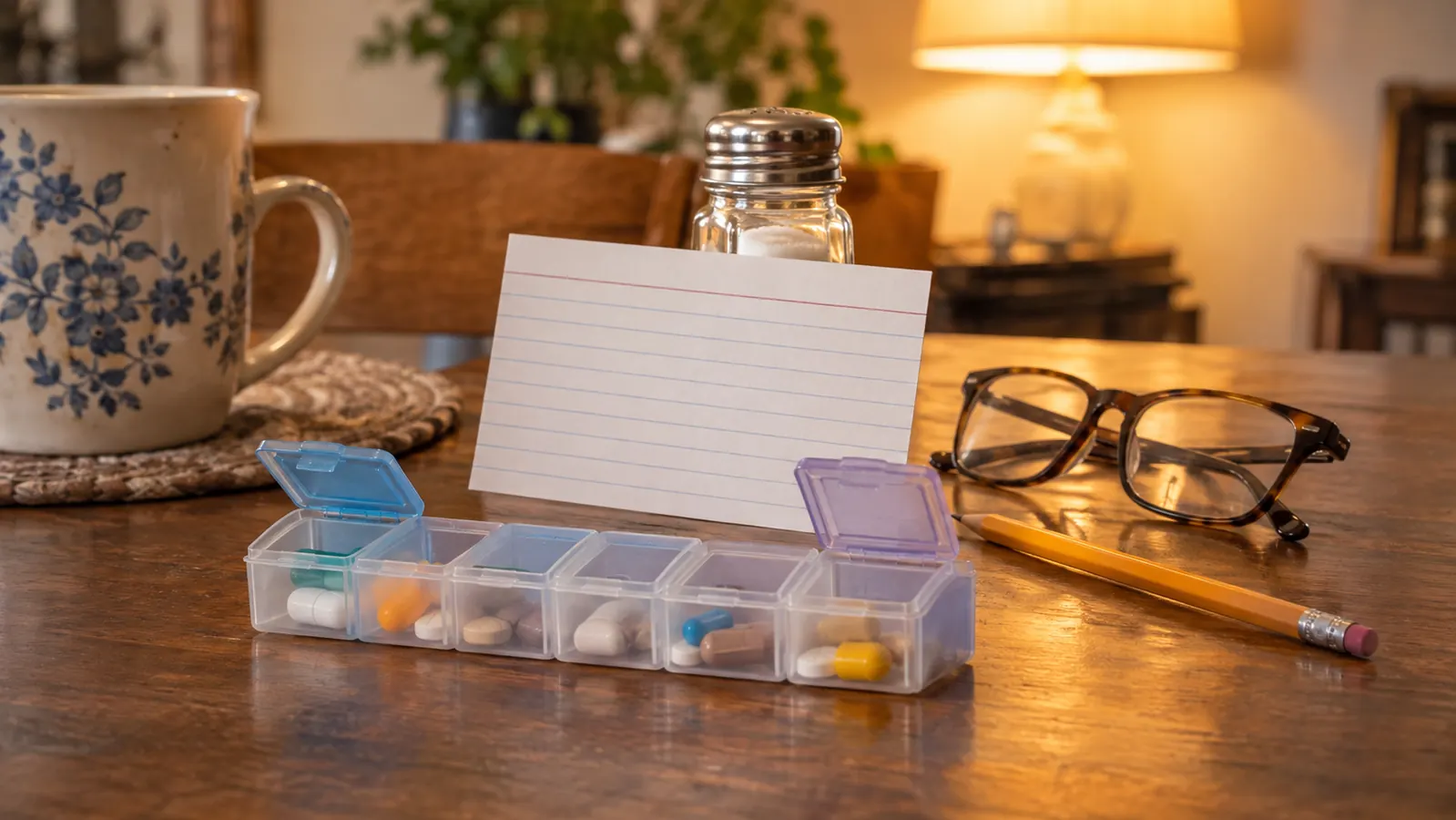
Dinner is about six. The magnesium goes in the PM lid of my blue seven day pill box, and that box gets filled every Sunday evening at the kitchen table with the index card propped against the salt shaker. Two tablets, one compartment, once a day, for 24 months. I have never taken it in the morning and I have never taken a second round later at night. When the pharmacist at my grocery store looked at my card, he suggested keeping the magnesium away from the multivitamin with iron, which is why the multivitamin sits in the AM lid at eight in the morning and this sits in the PM lid at six.
That is the entire routine. There is nothing to time, nothing to take on an empty stomach, nothing to refrigerate, nothing to shake. It goes with food because dinner is when I eat, not because the label requires a ritual. On the evenings I eat late, it goes late, and on the evenings I eat at the counter with a book, it still goes. Two years of that and I have forgotten it perhaps a handful of times, always on a Sunday when the box was empty and I had not yet filled it. The pill box is the reason the record is that clean.
The index card is the other half of it. I write down what I take, the amount on the label and when I started, one line per product, and I take the card to my yearly physical. My doctor has seen all five products on it, including this one, and she is the one who said magnesium was fine for me in the first place. That is the only reason I am comfortable writing any of this down publicly. I am not recommending my card to you. I am telling you that a card is a better habit than a memory, and that the person to show it to is your own doctor or pharmacist.
Two Years, Same Shelf
I have rebought this bottle without a break for two years now, always the same product, always the 240 count. That is not loyalty. It is that I do not want to redo the reading. Once a label has been checked against my index card and shown to my doctor, changing it means starting the whole thing over: the pencil, the glasses, the small print, the question at the next physical. Doctor's BEST has kept the label where I can find the same numbers, and that alone keeps me on the same shelf. If the label changed, I would notice, because I compare the new bottle to the card before the old one goes out.
A word on the 100 mg tablet, because it is the number people skip. Each tablet is 100 mg and the serving is two, which is how the bottle arrives at 200 mg. That means you can see exactly how the amount is built, which is more than some labels allow. It does not mean I get to tell you to take one or two. That is a question for your own doctor, and it is the same question I asked before the first bottle. What I can say is that the label is unusually clear about the arithmetic, and a clear label is worth something when you are the one standing in the aisle at sixty three with the glasses on.
What Nobody Tells You
Here is the first thing. The bottle is sold as a 240 count, and a person reads 240 and thinks of a year. It is 120 evenings. Four months, not eight, and that is the honest arithmetic of a two tablet serving. The second thing is that high absorption is a name, not a measurement you can perform at home. The third is that the serving is 200 mg, the tablets are 100 mg each, and the label is the place where that is written down. I am not telling anyone what amount to take. I am telling you where the numbers live and who to ask about them.
The fourth thing is duller and I wish somebody had said it to me. With a two tablet serving, this bottle is a poor fit for a pill box that already has a crowded PM lid. Two large tablets take up more room than two small ones, and my Sunday filling takes longer because of them. There are seven compartments in my box and this is the only product that needs two slots worth of room in one. If you use a smaller organizer, check the compartment size before you buy rather than after.
The fifth thing is about the alternatives, because the shelf is confusing and I have been confused by it. Magnesium citrate is right there beside this, often in a smaller tablet. I have never owned it and I have never taken it, so I will not tell you a single thing about what it would do for you. What I did was read both labels and ask the pharmacist at my grocery store, and he said that people's stomachs differ and that he could not pick for me. I stayed with the glycinate because it was the one my doctor had already seen on my card. That is the entire reason. Convenience and a settled question, not a verdict on citrate.
A 240 count bottle is 120 evenings, not 240. At two tablets with dinner I finish one in about four months, and no front label says so.
What I Liked
- Label states plainly that the 200 mg is per serving, two tablets
- 240 tablets at two a day is about four months of an easy evening routine
- Tablet form goes straight into a pill box, nothing to mix or measure
- No smell when the bottle opens, unlike two others in my cabinet
- Vegan, gluten free, soy free and unbuffered, all printed on the label
- Fits an upper cabinet shelf at roughly three inches by five
Where It Falls Short
- Large tablets, and you take two at a time
- The absorption language is the maker's wording and I cannot check it
- The benefit line on the listing carries an FDA disclaimer, so read it as wording
- No smaller or coated version inside the same bottle
- Two big tablets crowd a pill box compartment
Who This Is For
This suits someone who already has a settled answer from their own doctor about magnesium, who takes a tablet at the evening meal anyway, and who wants a bottle that lasts a season rather than a week. It suits a pill box person. It suits someone who would rather read a serving size than be surprised by one. It suits a small kitchen and a closed cabinet door. If you are that person, the arithmetic is friendly: one bottle, about four months, two tablets at dinner, one line on an index card, and a question saved up for the next physical.
Who Should Skip It
Skip it if a large tablet is a problem for you, because there are two of them and no smaller option in this bottle. Skip it if you are on any prescription and have not asked your pharmacist about timing, because this is a bottle with a two tablet serving and an evening slot that may not be your evening slot. Skip it if you are pregnant, or if you have a health condition, until you have had that conversation with your own doctor. Skip it if you wanted a powder or a gummy, since neither exists here. And skip it if you are buying because a review told you to. I am a retired librarian with a pill box and a pencil, not a clinician.
The serving size is the one detail that changes the math. Check it before you buy.
The Doctor's BEST label, the 200 mg per serving and the 240 count are all on the listing. Print it, or write it on a card, and take it to your own doctor or pharmacist first.
Amazon Check Today's Price on Amazon →