
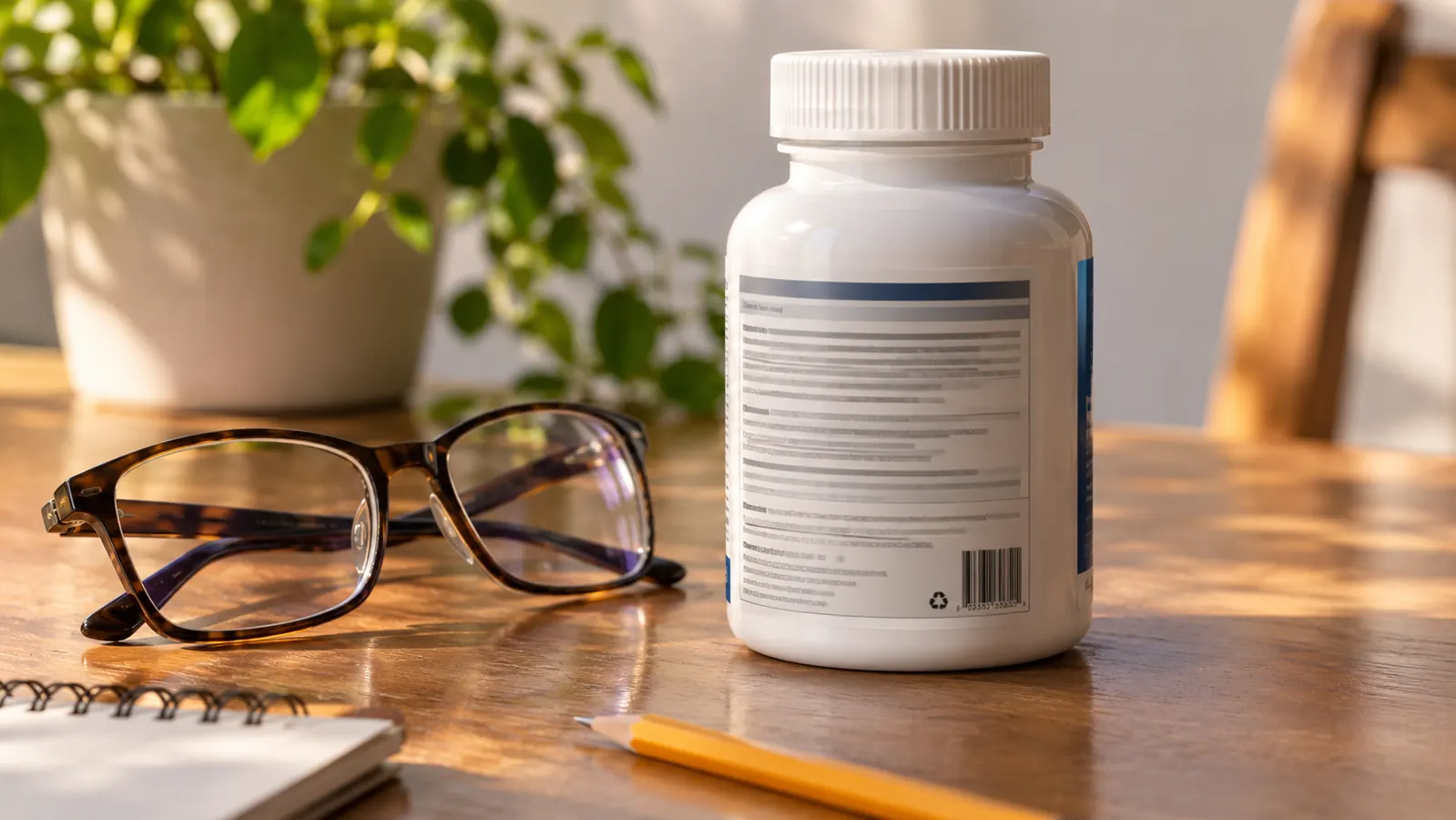
The vitamin aisle at my grocery store is forty feet long and the vitamin D section takes up two full shelves of it. I am sixty-three, retired three years now after thirty-one years as a middle school librarian in Dayton, and I do what I did at the reference desk: I take the bottle off the shelf, turn it over, and read the back before I read the front. The front of a supplement bottle is written to be read in about four seconds. The back is written to be read slowly, and it is the only part that answers a question you actually asked. Most of the bottles on that shelf are fine. The trick is telling which one is fine for you.
I have bought exactly one vitamin D3 in my life, and it is NatureWise Vitamin D3 5000 IU, the bottle of 360 mini softgels. My doctor asked me to add a daily D3 after a yearly physical. She picked the amount, she looks at it again each year, and I take one mini softgel at breakfast with food and water. That is the whole arrangement. Everything below is about the label, not about your health, because I am not qualified to advise you and I would not want the job. Ask your own doctor or pharmacist before you start anything, especially if you take a prescription, are pregnant, or manage a health condition.
One line of directions, one softgel, a bottle that lasts about a year
NatureWise Vitamin D3 5000 IU is 360 mini softgels carrying 125 mcg each, with organic cold-pressed olive oil. The listing says not to exceed one softgel daily, and the amount was my doctor's call for me. See today's price, then make the number a conversation with your own doctor.
Amazon Check Today's Price on Amazon →Step 1: Read the serving size before you read the big number
Every Supplement Facts panel opens with a serving size, and it is the line everyone skips. On a softgel bottle it usually reads one softgel. On a gummy it may read two pieces or three, and then every number in the column below is the amount in two or three, not one. I read the serving line first for that reason alone. Two labels can carry the same looking number and mean completely different things, and the only difference between them is a small line at the top that nobody photographs.
On the NatureWise bottle the serving is a single mini softgel, and the bottle holds 360 of them. That one line does two jobs at once. It tells you what a day looks like, and it tells you how long the bottle lasts at that rate. Mine lasts about a year. I am on my third bottle, and I have bought nothing else in the D section in thirty months.
The word mini is doing quiet work there, and it is worth reading as carefully as the numbers. A softgel the size of a grain of rice is a different product from a tablet the size of a button, even when the label reads the same. I can swallow this one with ordinary water at the kitchen sink, no tilting my head back and no second try. For a person my age that is not a small thing, and no advertisement ever mentions it.
Step 2: Read the amount twice, because it is printed twice
The amount per serving on my bottle is printed as 5000 IU, and the same line gives it as 125 mcg per softgel. Two units, one number, and I like seeing both, because it saves me doing arithmetic while holding a cart. IU and mcg are not interchangeable words on a label, and a bottle that shows only one of them has not done anything wrong. It has simply left you with one less piece of paper to check.
Here is where I want to be plain, because this is the number people copy off a stranger's card. 5000 IU is a strong softgel. It is not a number I chose. It is not a number I would choose for anyone else, and it is not a number to take from an article, mine included. My doctor picked it after a physical and she rechecks it at the next one. If you are standing in the aisle and the number on a bottle looks large to you, that is the exact moment to set it down and make a phone call rather than talk yourself into it.
The amount line is also how you catch an overlap. My multivitamin already carries some vitamin D. I found that with a pencil, reading two labels side by side at my kitchen table, and I brought both to my doctor. She was fine with the combination for me. That was a decision about my card, made in a little room with her, and it does not transfer to yours. Overlaps are ordinary. Guessing at them is not.
Step 3: Read the small print under the number
Under the big number is a short list of everything else in the softgel. On this bottle the vitamin D3 is carried in organic, cold-pressed olive oil, and the listing says the oil is pressed without heat or hexanes. I cannot verify a manufacturing claim from my kitchen table and I will not pretend otherwise. What I can tell you is that the ingredient list is short enough to read in one breath with my reading glasses on, and that is the standard I actually use.
The same panel tells you the form and a few other things worth a glance. This one is a softgel, it is unflavored, and it is gluten free. Unflavored matters more than it sounds. I once took a flavored supplement that repeated on me until lunch, and I would rather have no taste at all than a cherry ghost at eight in the morning. A softgel with oil in it also has a faint smell when the cap first comes off. That is ordinary, and it is not a reason to throw the bottle away.
What I look for in that small print is length and plainness. Three or four ingredients I can pronounce beat a paragraph of extracts and blends, not because blends are bad, but because I cannot read them and I do not want to pretend I have. If a label makes me feel stupid, I put it back. That is not a scientific test. It is the test of a person who has to keep doing this every morning for years.
Step 4: Read the directions line and follow the asterisk
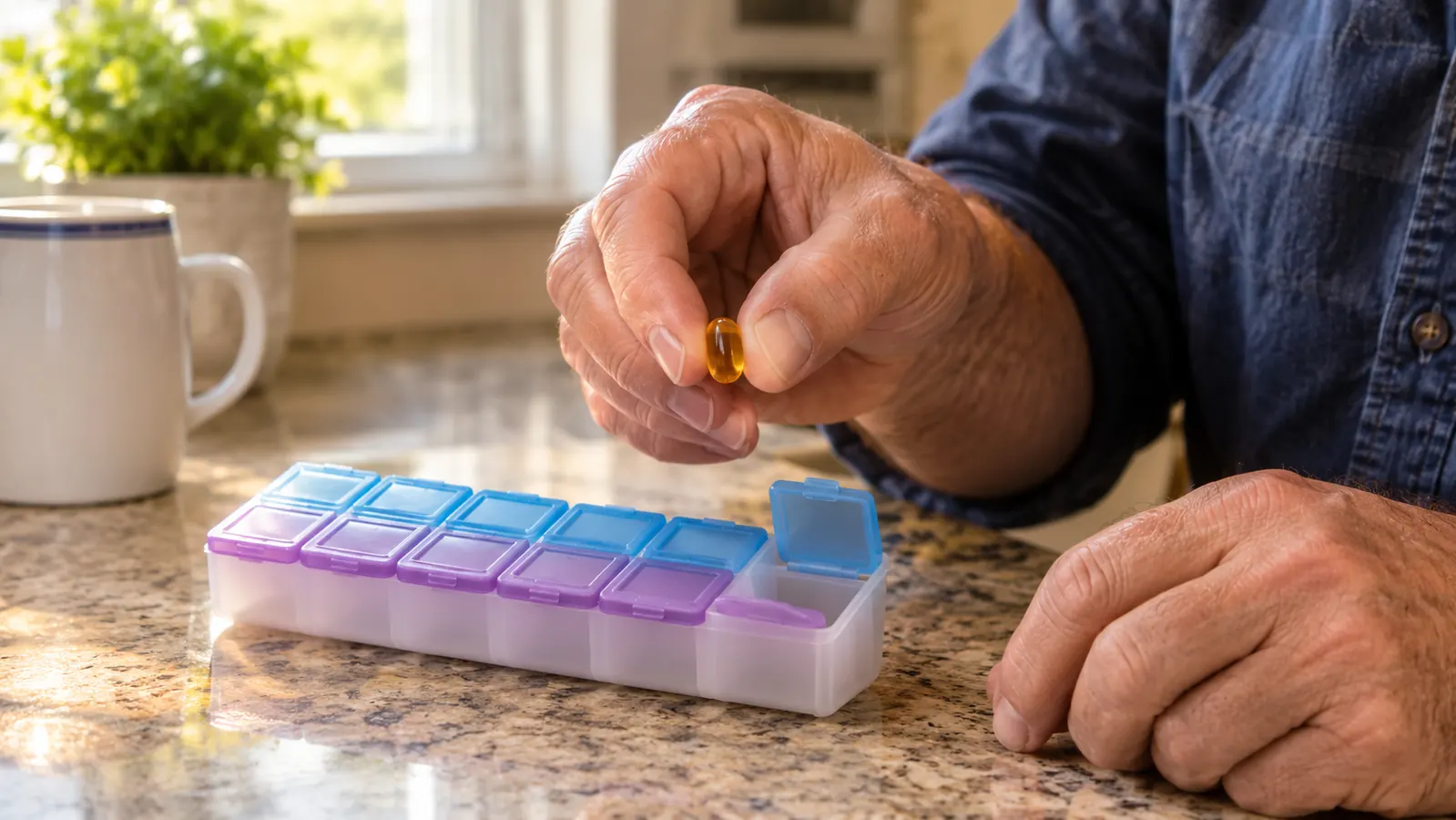
The Directions line on my bottle says not to exceed one softgel daily. That is the entire instruction, one line, which is why I trust myself to follow it. A label that needs a paragraph of directions is a label I will misread on a Monday. I take one mini softgel at breakfast, with food and water, and it goes into the morning lid of my pill box on Sunday night so that Monday morning requires no judgment from me at all.
Then follow the asterisk. The listing uses support language, bone health support, calcium absorption support, immune function support, muscle health support, with a mark after it that leads to a sentence about the Food and Drug Administration not having evaluated that statement. I read that sentence every time I open a new bottle, and I think it is the most honest line on the package. It tells you exactly how much weight to put on the words above it. The support wording is the maker's. The asterisk is the limit of it.
What that comes down to in my kitchen is this. I cannot tell you I feel a difference from any one bottle, and I would not trust anyone who says they can. What I can judge is whether the label is legible, whether the softgel is small enough to take without a performance, whether the directions fit on one line, and whether I still manage it on an ordinary Tuesday in February. Those are the things a label can honestly promise. The rest belongs to your doctor.
I cannot tell you I feel a difference from any one bottle, and I would not trust anyone who says they can.
Step 5: Put the bottle down and judge the bottle
The last step has nothing to do with print. Pick the bottle up and look at the object itself. Mine measures about 2.88 by 2.88 by 5.38 inches and weighs 1.59 ounces, so it stands in the cabinet to the left of my sink without my moving anything else out of the way. It is a bottle with a cap, not a wide jar, and it opens in a quarter turn. That sounds like nothing. It is the difference between a thing that takes four seconds and a thing I quietly stop doing.
Storage is the part nobody reads until the softgels stick together. The listing says plainly that softgels can clump in a warm place. My cabinet is away from the stove, the door stays closed, and part of that is temperature and part of it is Dewey, my cat, who is eleven and firmly believes the counters belong to him. Every bottle in this house lives behind a closed door. The count is a real trade as well. 360 softgels at once is a long supply, and if your doctor changes the amount you are holding the old number for a year. I took that trade and I would take it again.
Then I write it down. One index card, kept in the cabinet beside the bottles, with what I take and when. Not because I will forget, though I might, but because a card is something I can hand to a doctor instead of reciting from memory while a cuff tightens on my arm. I take that card to my yearly physical. My doctor has seen all five things on it, including this one, and that is the only reason I trust the list.
What Else Helps
A seven day pill box does more for label reading than anything on my phone. Mine is blue plastic with AM and PM lids, filled every Sunday evening at the kitchen table. The D3 goes in an AM lid with the multivitamin, the B-100 and the vitamin C. The magnesium goes in the PM lid at dinner, because the pharmacist at my grocery store suggested keeping it away from the multivitamin with iron. If I am opening a bottle at eight in the morning, I have already failed at Step 5.
A pharmacist costs nothing and is faster than a search engine. The one at my grocery store is a man whose name I have never used here, and he has read every label I have brought him, including the question of whether two bottles with overlapping vitamins were worth worrying about. I bring the bottles themselves, not my memory of them. He reads the same panel I read and he reads it in about nine seconds.
One more habit, and then I will leave you to your own aisle. I read the label of anything I am about to buy twice, once standing under the fluorescent lights with a cart, and once at home with a pencil. In the store I hurry. At home I do not. Twice now the second read has changed my mind about a bottle that looked fine on the shelf. The label never changed. My attention did.
And the last thing, which I say in every one of these notes because it matters more than the label: ask. Ask your own doctor or pharmacist before you add anything, especially if you take a prescription, are pregnant, or manage a health condition. My index card is a record of decisions made with my doctor about my body. It is not a plan, and it is not a shortcut past that conversation.
Read the back of the bottle before you decide anything at all
NatureWise Vitamin D3 5000 IU is 360 mini softgels of 125 mcg each in organic, cold-pressed olive oil, with a directions line that says not to exceed one daily. My amount was my doctor's decision for me. Make yours a conversation with your own doctor, then check today's price.
Amazon Check Today's Price on Amazon →