
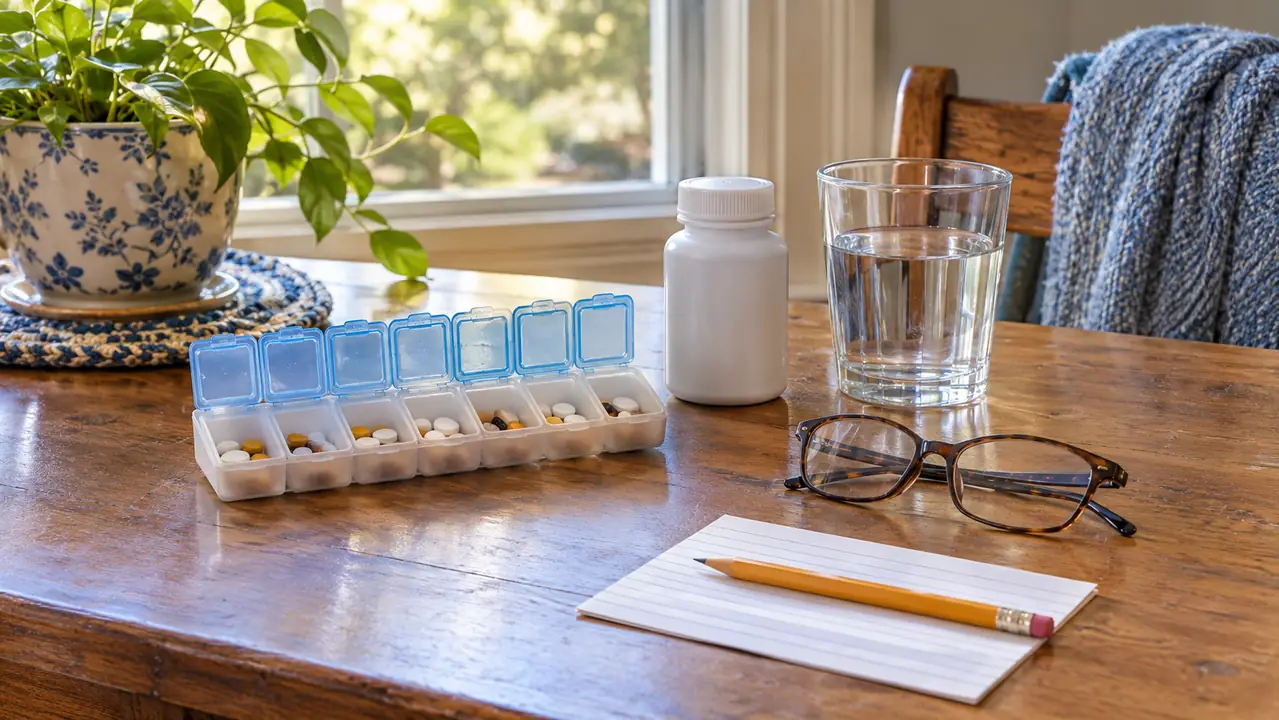
The wall of vitamin bottles at the grocery store is where most morning routines quietly fall apart. I stood in front of that wall three years ago, the month I retired, with a cart, a pencil and no idea which bottle was the sensible one. I am 63, I live alone in Dayton, Ohio, and I read labels the way I used to read reference books: slowly, with my reading glasses on and a pencil in my hand.
Here is what I worked out over those three years. The routine matters more than the bottle. A plain multivitamin you actually take every morning beats a shelf of interesting bottles you skip. The one still written on my index card is Nature Made Multivitamin Tablets with Iron, 130 tablets, one tablet daily with water and a meal. I bought it 36 months ago and I have rebought the same thing every time since. What follows are the five steps I used to build a morning that runs without me thinking about it. Before you copy a single one of them, ask your own doctor or pharmacist, especially if you take a prescription, are pregnant, or have a health condition.
The bottle that has stayed on my index card for three years
Nature Made Multivitamin Tablets with Iron, 130 tablets. The directions take one line: one tablet daily with water and a meal. Bottle, tablet form, gluten free, and marked USP Verified on the label.
Amazon Check Today's Price on Amazon →Step 1: Read the label before you read the front of the bottle
The front of a bottle is an advertisement in a small font. The back is where the information lives. Turn it around and find two things first, the directions line and the serving size. On the Nature Made bottle the directions read one tablet daily with water and a meal, and the serving size is one tablet. That is the whole instruction, and I liked that it fit on one line, because a direction I can hold in my head is a direction I will follow on a Tuesday when I am running late.
Next, read what the tablet actually holds. This one lists 23 key nutrients including Vitamin A and Vitamin C, with beta carotene named among the special ingredients. The bottle says gluten free and the tablets are unflavored. None of that tells you whether the tablet is right for you. What it tells you is whether the label is specific enough to respect, and this one is. The numbers are printed rather than hinted at, and the bottle carries the United States Pharmacopeia verification mark, which is a third party check rather than the maker's own word.
Then read the part nobody enjoys. This bottle contains iron. Iron is the line on that label I want every reader to slow down for, not because it is a bad thing, but because it is the kind of thing that has to be a decision between you and your own doctor. The front of the label also uses words like immune support and bone support, and an asterisk sends you to a line that says the FDA has not evaluated that statement. I read that line out loud the first time, and then I stopped expecting the bottle to do anything the label itself could not say. It is a tablet with vitamins in it. That is all it is.
Step 2: Attach the tablet to a meal you already eat
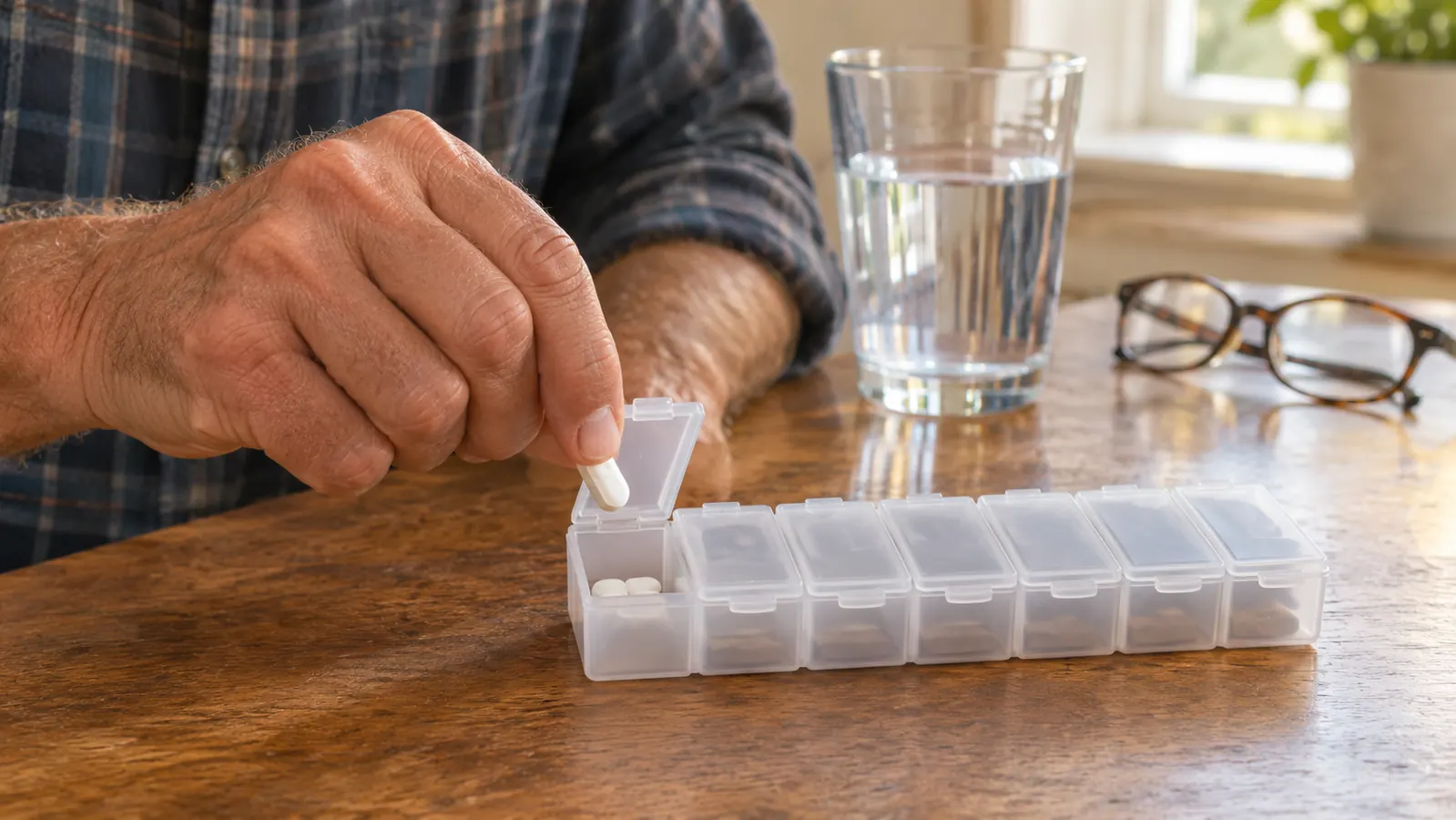
The directions say with water and a meal, so the routine only works if it lands on a meal that already exists in your day. Mine is breakfast, about eight in the morning, always at the kitchen table. I did not build a new habit. I bolted the tablet onto a habit I have had since I was a girl, which is a bowl of cereal and a cup of coffee. That is the whole approach, and it is less clever than it sounds.
The water matters more than I expected. I keep a glass on the counter beside the pill box and I fill it before I sit down, because a large tablet with only a sip of coffee is a poor start to a morning. The tablet is on the big side and it has no flavor, which suits me. What I noticed in the first week is the smell, a plain vitamin smell when the cap comes off. It is not offensive. It is just there, and if you are someone who notices smells, you will notice it every morning.
One more note on timing. I do not take it with the first sip. I take it halfway through the bowl. That is not a recommendation, it is simply where it lands in my morning, and the label's own direction is the rule I follow. If your breakfast is a cup of coffee in the car, pick a different meal rather than skipping the tablet. The routine is the point.
Step 3: Buy one pill box and fill it once a week
I fill a blue plastic seven day pill box with AM and PM lids every Sunday evening at the kitchen table, reading glasses on, pencil out. That is the step that keeps everything else running. The box answers the question of whether I have taken it this morning without me opening a bottle, counting what is left, and doing arithmetic in my head before I have finished my coffee.
Filling it takes about four minutes. I set the bottle on the table, flip open the Sunday through Saturday lids in a row, and put one tablet in each morning section. Then I close it and put the bottle back in the cabinet left of the sink. Because I do the whole week at once, a forgotten Tuesday is visible immediately. The Tuesday morning lid is still full and I know it. I do not scold myself. I write it on the card and carry on.
If a pill box sounds like something only your grandmother owned, I understand. My grandmother had one too. But the box is the reason a plain bottle of 130 tablets lasts me a little over four months without a single week of guesswork. The bottle itself is modest, 2.44 inches across and 4.38 inches tall, and it takes up almost no room on the shelf. The box takes up more space than the bottle does.
A bottle of 130 tablets at one a day lasts me a little over four months. That means I handle the same decision about four times a year instead of every week.
Step 4: Keep one index card, and take it with you
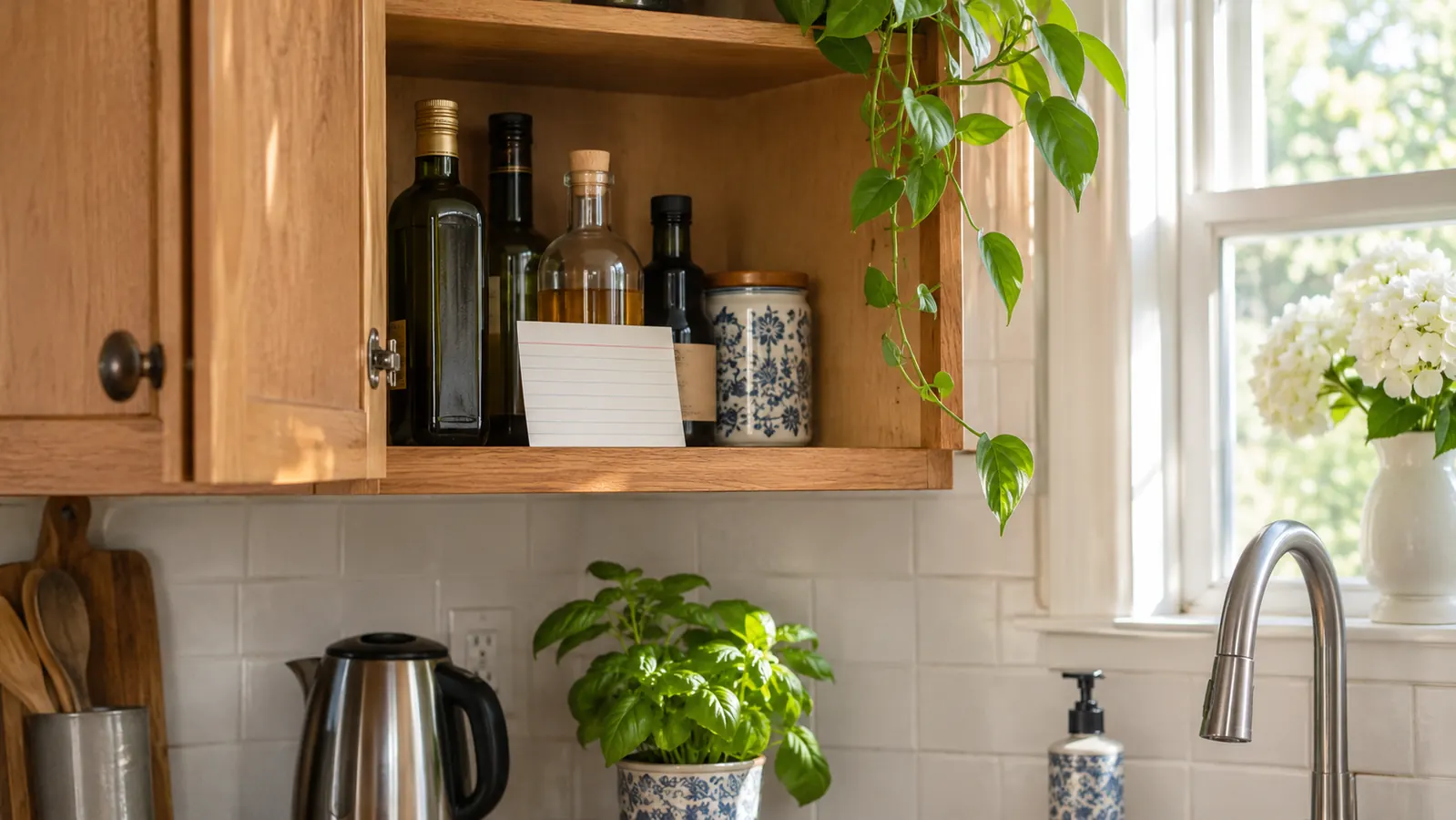
In the cabinet beside the bottle I keep one index card with what I take written on it in pencil. Not a list on my phone, not a note in a drawer. A card in the cabinet where the bottles are, so it is in my hand when I open the door. It says the product, how many, and when. Pencil, because a card in a cabinet gets changed and pencil can be changed.
Twice a year the card leaves the kitchen. It goes in my bag for my yearly physical and my doctor reads it. That was her idea, not mine, and it is the reason I have never had to rely on memory for anything on that card. I also take it to the pharmacist at my grocery store, who is a patient man and has answered every question I have carried him, including whether two items on the card overlap. He is the one who suggested keeping the evening tablet away from the morning ones, and I have done that ever since.
This is the step people skip and I think it is the most important one. A routine you cannot describe to another person is a routine you do not fully understand. If you cannot write it on a card in pencil, it is too complicated. The multivitamin is the easiest line on my card to write: one tablet, morning, with food and water.
Step 5: Leave it alone for a season
The temptation, once a routine works, is to improve it. I have done that with other things in my life and it never ends well. What I do now is buy one bottle, put it in the cabinet, and leave the arrangement alone for at least four months, which is roughly how long this bottle lasts. One change at a time, and never in the same week as a doctor's appointment or a trip out of town.
There is a reason for the patience beyond temperament. The multivitamin already holds some vitamin D, vitamin C and B vitamins, and I know that because I sat at the table with a pencil and read the panel on every bottle in the cabinet. When I found the overlap I did not adjust anything myself. I showed the card to my doctor and she was fine with it for me. For me is the important part of that sentence. That was a decision about my body, made with my doctor, and it is not a decision I can make about yours.
And here is the honest part, the part I would want from a friend. I cannot tell you I feel a difference from any one bottle, and I would not trust anyone who says they can. What I can judge is the label, the size of the tablet, the smell when the cap comes off, the bottle on the shelf, whether I keep it up, and how long it lasts. On those things I have three years of notes, and the notes say the routine holds. That is a smaller claim than most bottles make on the front. It is the only one I can stand behind.
What Else Helps
The cabinet matters more than people think. Mine is the upper cabinet left of the sink and the door stays closed. The reason has four paws. Dewey is eleven, he is a gray tabby, and he treats the kitchen counters like a staircase he owns. Vitamins are for people and he never gets any, which is exactly why the bottles live behind a closed door and away from the stove.
A glass on the counter, a card in the cabinet, a box that gets filled on Sunday, and one bottle at a time. Those are the four things that keep this running, and only one of them cost anything. I would add a fifth: buy a size you will actually finish. A 130 tablet bottle is a little over four months at one a day, and that is the right length for me. If you are unsure whether you will keep going, a smaller package is a fair way to find out, and a short bottle on the shelf is better than a big one going stale.
The one alternative I actually lived with was a store brand gummy, which I took for five months before the Nature Made bottle. I finished that jar and never bought another. The gummies stuck together, the serving was more than one, there was sugar on the label, and the nutrient list was shorter than I wanted to read. That is a convenience complaint, not a health one. A gummy is fine for plenty of people. It was not fine for my pill box, because a gummy does not sit in a Sunday morning lid the way a tablet does.
One tablet, one line of directions, one bottle in the cabinet
If a plain morning is what you are after, this is the plain one I have kept for three years. Nature Made Multivitamin Tablets with Iron, 130 tablets, one tablet daily with water and a meal. Ask your own doctor or pharmacist before you start, especially about the iron.
Amazon Check Today's Price on Amazon →