
The label on this jar is short. That is the only reason I picked it up off the shelf. I am 63, retired three years now after 31 years as a middle school librarian in Dayton, Ohio, and I read labels the way I used to read reference books: slowly, with my reading glasses on and a pencil in my hand. Most vitamin bottles hand you a block of type the size of a postage stamp. The Sports Research High Potency Vitamin C label was a list I could finish standing right there in the aisle. I bought it 12 months ago with my own money and I am on my second jar. This is what I can tell you that the product page does not.
What I cannot tell you is whether it does anything for me. I cannot tell you I feel a difference from this bottle or from any other, and I would not trust anyone who says they can. What I can judge is the label, the capsule, the jar, how easy it is to keep up with, and how long it lasts before I have to buy again. That is the whole of this review. If you came for a story about how one vitamin changed somebody's winter, you will not find it here, and I would be careful with the pages that have one. Ask your own doctor or pharmacist before you add anything to your day, especially if you take a prescription, are pregnant, or are managing a health condition.
The Quick Verdict
A short ingredient list, a vegan capsule, and a jar that ran about 8 months at one capsule each morning. The capsule is large, the jar is 6.25 inches tall, and 1000 mg is a bigger number than most of us expect to see on a label.
Amazon Check Today's Price →Short label. Big number. Read both before you decide.
Sports Research High Potency Vitamin C, 1000 mg, 240 veggie capsules in a jar. I take one at breakfast and no more. Whether it belongs in your day is a question for your own doctor or pharmacist, not for me.
Amazon Check Today's Price on Amazon →How I've Used It, Morning After Morning
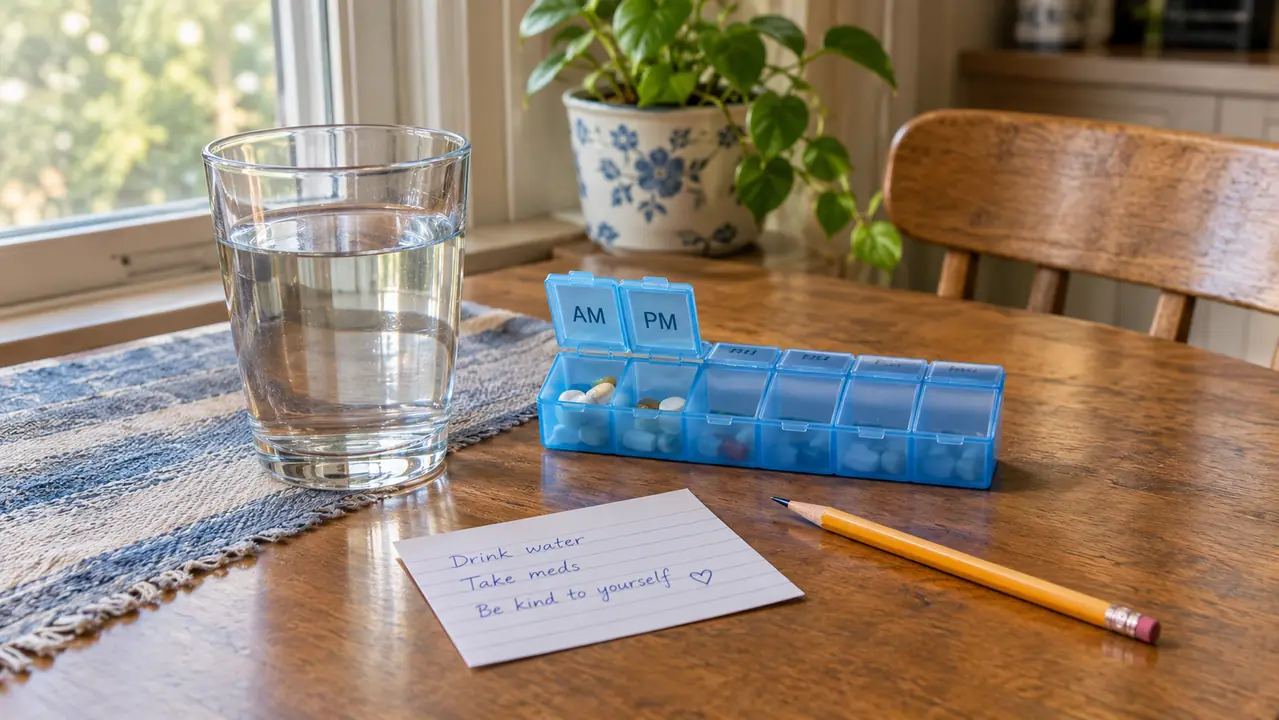
I take one capsule at breakfast, about eight in the morning, with food and a full glass of water. That is the entire routine. It goes into the AM lid of the blue plastic 7 day pill box I fill every Sunday evening at the kitchen table, beside the multivitamin, the vitamin D3 softgel and the B capsule. I have taken it that way for 12 months without a break beyond an ordinary forgotten morning, and I am on my second jar. One jar carried me about 8 months at one capsule a day, which is the single most useful number on this page for someone standing where I stood.
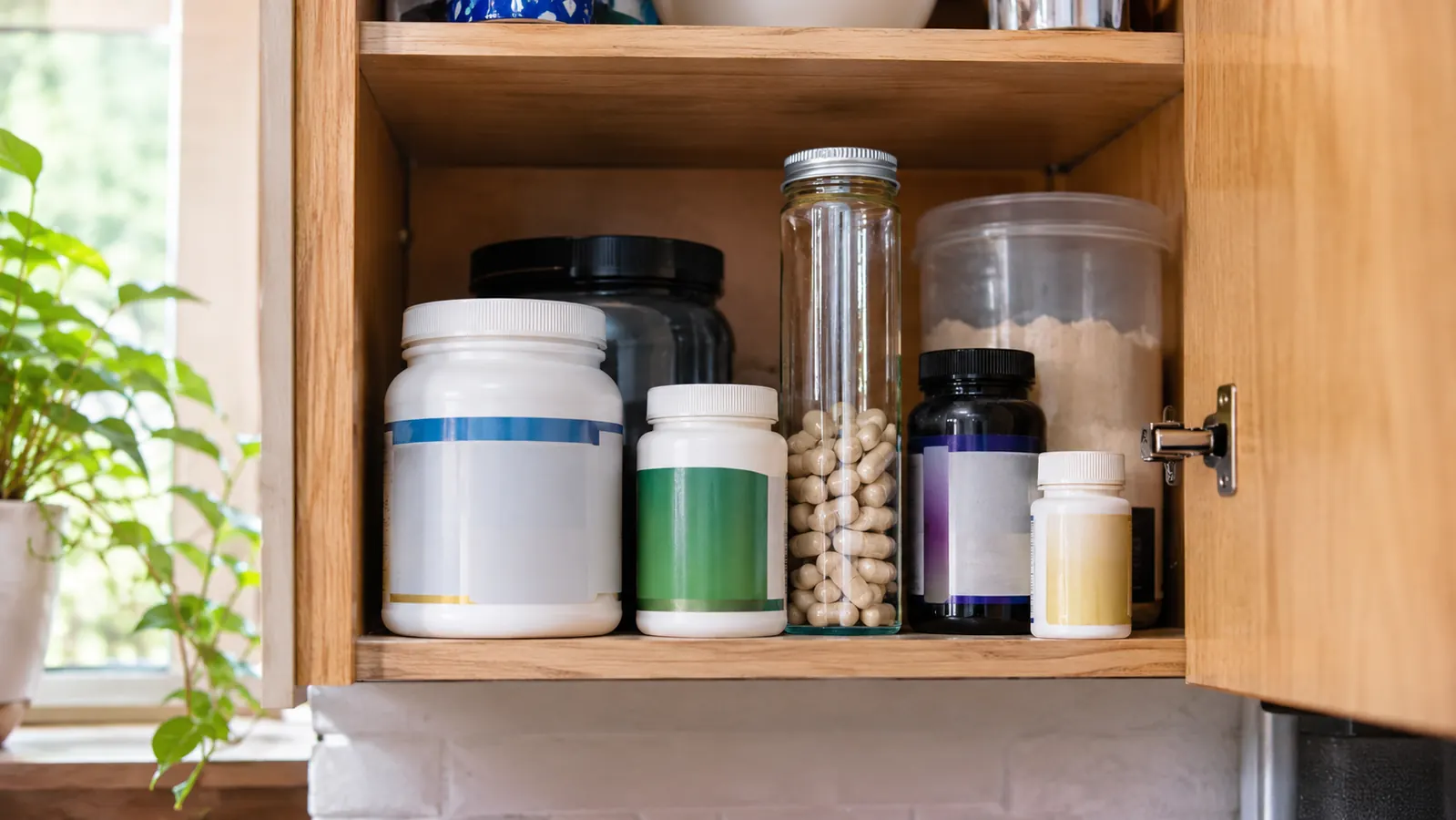
The jar lives behind a closed cabinet door, in the upper cabinet left of the sink, and that is not about the vitamin. It is about Dewey, my eleven year old gray tabby, who treats the kitchen counters as inherited property. Vitamins are for people. Dewey gets none, ever, and the door stays shut. If you have a cat who works a cabinet open, put this somewhere he cannot reach, because a capsule on a counter looks like a toy to a cat who has already decided the counter is his.
I keep one index card in that cabinet with what I take written on it in pencil. I took the card to my yearly physical and my doctor has seen all five products on it, this one included. That card is why I can tell you exactly what I take and when, and it is also how I noticed that my multivitamin already carries some vitamin C. That observation is a question I will come back to, and it is the reason I did not simply add this jar and stop thinking about it.

What the Label Actually Says
The primary ingredient line reads vitamin C as ascorbic acid. The item form is a capsule. The container is a jar, and the count is 240 veggie capsules. The diet line says gluten free and vegan. The flavor line says unflavored, which matters more than it sounds, because it means nothing has been added to dress it up. The listing also names the dose release method as immediate release, a phrase I read twice and still cannot turn into anything useful at my kitchen table. What I can tell you is that it is a capsule, and it goes down like a capsule.
The product benefits line reads, and I am quoting it exactly: Supports Immune Health, with an asterisk after it. That asterisk is not decoration. It means the statement has not been evaluated by the Food and Drug Administration, and the small print underneath says the product is not intended to diagnose, treat, cure or prevent any disease. I am not going to tell you it does any of that, because I cannot and would not. I am telling you what is printed on the thing in my cabinet, because you should read the asterisk before you read the sentence above it. That is the habit I would hand to anyone.
The suggested use on the label reads one capsule one to three times daily, with or without food. I take one, at breakfast, and that is a decision I made with my doctor's knowledge rather than a number I am handing to you. I will not tell you what to take. I will tell you that the label leaves room for more than one capsule, that the jar holds 240 of them, and that a person ought to know why they are reaching for a second one before they do. The first capsule is the easy one to explain. The others need a reason.
The Capsule Is Larger Than the Listing Suggests
Nobody on the product page mentions the size of the capsule, and it was the first thing I noticed. It is not a small pill. I take it with a full glass of water and I do not attempt to dry swallow it, and I would not hand it to someone who struggles with pills without saying so out loud first. My own test is simple: if I have to think about it, it is a big capsule. I think about this one, every morning, briefly.
On the other hand, it is one capsule, not two or three, and that counts for something when you are at the counter at eight in the morning with a pill box open in front of you and a cat on the counter you did not invite. The vitamin D3 softgel in the next lid is easier to swallow. The vitamin C is the one that asks for attention. Both go down with the same glass of water, and then I close the cabinet and get on with the day.
The Jar, the Cabinet and the Shelf
The listing gives the dimensions as 2.75 by 2.75 by 6.25 inches, and the weight as 12 ounces. That is a tall, narrow jar, and tall and narrow is exactly what it is in practice: it stands on the shelf rather than lying down beside it. In my upper cabinet the shelf is short, and the Sports Research jar stands a head taller than the bottles next to it. It fits. It simply does not fit quietly. If your cabinet is tight or your shelf is low, measure before you order, because 240 capsules arrive in a container built to hold them and not to save you space.
I will give the jar one advantage over a bottle. I can see how much is left without shaking it. The capsules settle, the level drops, and somewhere around the sixth month I can tell a new jar is coming. The opaque bottles do not do that for me. It is a small thing, and it is the kind of small thing that decides whether a person rebuys.
The 1000 mg Number Deserves a Question
Here is the part I would want a friend to say to me. My multivitamin already carries some vitamin C. I found that with my pencil, comparing the two labels at the kitchen table, and then I took both labels to my doctor and asked. Her answer was that it was fine for me. It was a decision for me, in my body, with my history, and it is not a decision I can make for you or anyone else reading this. If you already take a multivitamin, put the two labels side by side and take the question to someone qualified to answer it.
I will also say plainly that 1000 mg is a large number to see on a label, and a large number is a reason to ask rather than a reason to skip the asking. I am not going to quote a daily amount or an upper limit at you. I am not qualified to, and the numbers you should be reading are the ones on your own bottle, with your own pharmacist standing there. What I can report is this: after 12 months at one capsule a morning, nothing has happened to make me change it, and my doctor has seen the card.
The Chewable I Looked At Instead
I never owned a chewable vitamin C. I stood in the aisle and read two labels, and I put both back. What I saw was sugar and flavoring I did not want in something I take every morning for years, and a shorter list of what I did want. I have nothing against a person who chooses a chewable. It is simply not what I was shopping for. My test is whether I would still be taking the thing in three years, and a sweet tablet at eight in the morning did not pass that test for me.
There was a second reason, and it is the practical one. A chewable does not go neatly into a pill box. It rattles, it crumbles at the corner, and it takes up the space of two capsules. My whole system depends on filling that box on Sunday evening and not thinking again until the next Sunday. Anything that does not fit the box does not fit my week, and that is a duller argument than the label argument but it is the one that decides things in this house.
What the Listing Does Not Tell You
The listing will not tell you how long a jar lasts. Mine ran about 8 months at one capsule a day, which is the useful number for me and might be the wrong number for someone taking more than one. It will not tell you the capsule is large. It will not tell you the jar stands 6.25 inches tall. It will not tell you that 240 capsules is a commitment of most of a year, which is a fine thing if the label suits you and a mildly annoying thing if your doctor changes your mind in month two.
The page shows a rating of 4.8 from more than 10,000 reviews, and I will be honest with you about what I think of that. A rating tells you a great many people bought something and were not irritated enough to complain. It does not tell you the thing works, because nobody can feel a vitamin working, including the people leaving five stars. What reviews are good for is the small practical complaints, the ones about size and shipping and containers that arrive warm, and I read those before I ordered. I am handing you mine in the same spirit.
What I Liked
- A short ingredient list I could read all the way through standing in the aisle
- Vegan capsule, gluten free, unflavored, with nothing added to dress it up
- One capsule a morning, and a jar that ran about 8 months
- The clear jar shows how much is left without shaking it
- 240 capsules means fewer reorders and one less thing to keep track of
Where It Falls Short
- The capsule is large and I take it with a full glass of water
- The jar stands 6.25 inches tall and takes shelf room in a short cabinet
- 1000 mg is well above what my multivitamin carries, which took a conversation with my doctor
- 240 capsules is most of a year, which is a long commitment if anything changes
- I cannot tell you I feel a difference, and neither can anyone else
The label was short enough that I read all of it standing in the store, and that is rarer than it should be.
What I'd Say If You Were Standing in the Aisle
Turn the jar around before you turn it over to look at the rating. Read the ingredient line, read the suggested use line, and read the asterisk, because the asterisk tells you what the sentence above it is worth. Then look at the count and do the arithmetic for your own morning: one a day, 240 in the jar, most of a year. If that number feels too long, buy nothing and think about it. Nothing on the shelf is going anywhere.
Then take the label to your doctor or to the pharmacist at your grocery store and ask the question you actually have. Mine was about the multivitamin overlap. Yours will be something else, and it will be a better question than any I could write down for you. A person with a pencil and a question gets further in that aisle than a person with a cart and a coupon, and I say that as someone who has been both.
Who This Is For
This suits someone who reads the label before buying, who wants a short ingredient list and a capsule rather than a gummy or a chewable, and who takes their things at breakfast and wants the container to last. If you keep an index card, if you show your doctor what you take once a year, if one capsule is easier for you than three, this fits that kind of morning. It also suits a person who likes seeing how much is left without guessing, and who does not mind a tall jar on the shelf.
Who Should Skip It
Skip it if you have trouble with large capsules, because this is one and there is no way around that. Skip it if you already take a multivitamin carrying vitamin C and have not asked anyone whether adding more makes sense for you. Skip it if a tall jar will not fit where you keep things, or if you want something you can chew. Skip it, frankly, if you want a bottle that promises you a feeling by Friday, because no vitamin is that and this one does not pretend to be. And skip it if you are not going to ask your own doctor or pharmacist first. That is the one instruction I will give you plainly, and I will not soften it.
One capsule, one short label, and one question for your doctor.
Sports Research High Potency Vitamin C, 1000 mg, 240 veggie capsules in a jar. Read the label the way I did, pencil in hand, then ask your own doctor or pharmacist whether the number suits you. That order matters more than the order button.
Amazon Check Today's Price on Amazon →