
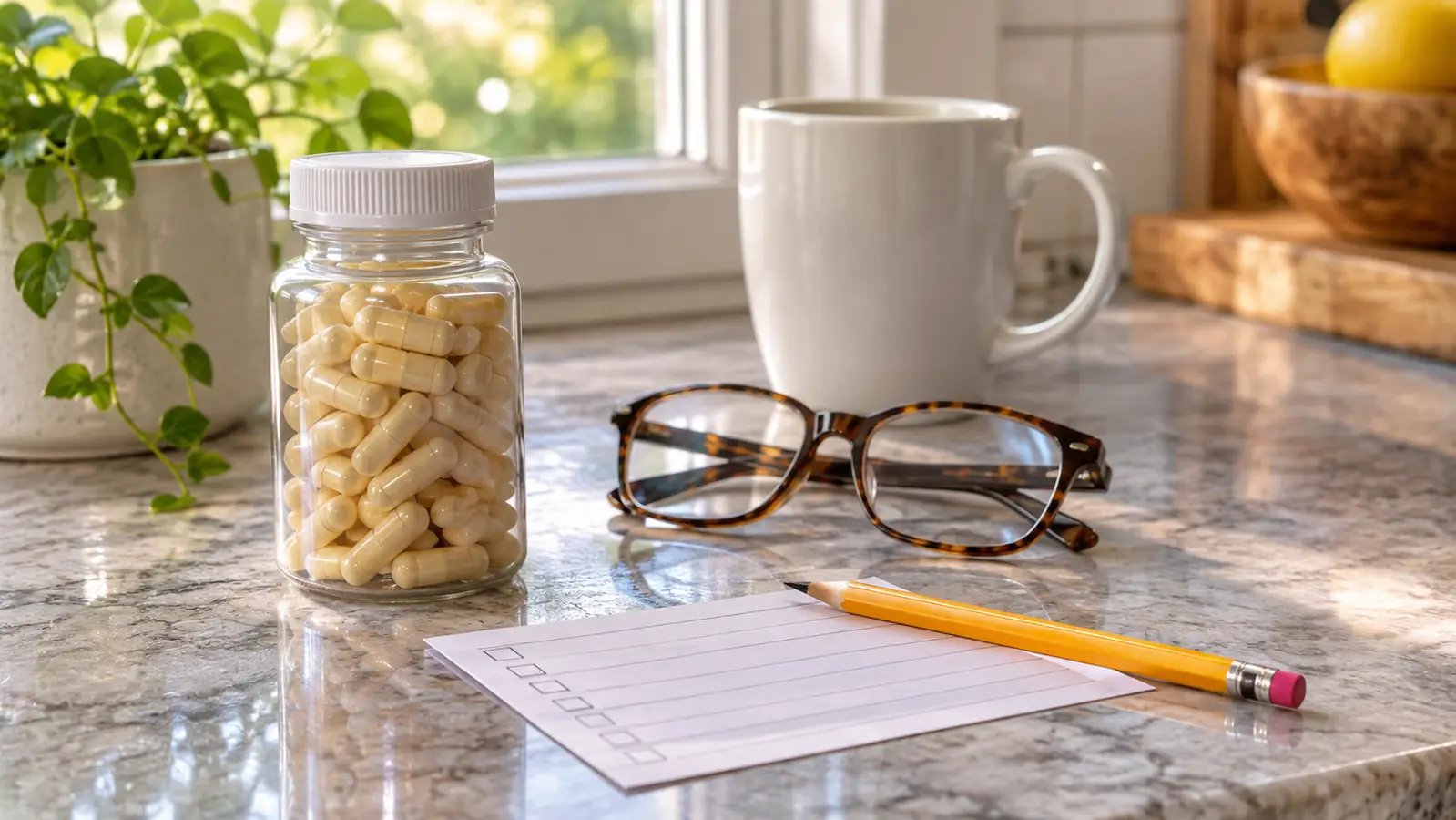
The vitamin C shelf at my grocery store takes up more room than the cookbook section did at the middle school library where I worked for 31 years. Bottles, jars, chewables in a cardboard tube, powders in a canister the size of a coffee can. I retired three years ago and I still walk that aisle on Tuesdays, and I still turn things around to read the back of the label on products I have no intention of buying. Here is what I have learned standing there with my reading glasses pushed up on my head. The hard part is not finding vitamin C. The hard part is deciding how much of it you are going to swallow, how often, and whether you can keep that up on a wet Tuesday in February.
Twelve months ago I settled on Sports Research High Potency Vitamin C, the 1000 mg veggie capsules in the 240 count jar. I take one capsule at breakfast with a full glass of water, and I have not missed many mornings. I am on my second jar. I bought it myself with my own money, the same as the other four bottles in my cabinet, and I am telling you about it because the label is the easiest one I have read in that aisle. Not because I think it will do anything dramatic for you. I cannot tell you I feel a difference from any one bottle, and I would not trust anyone who says they can.
One capsule at breakfast, and a label short enough to finish standing up
Sports Research High Potency Vitamin C is 1000 mg in a single veggie capsule, 240 to a jar, suggested use one capsule up to three times daily with or without food. That is nearly the whole label. Read it against your own morning before you buy anything.
Amazon Check Today's Price on Amazon →Step 1: Start at the back of the jar, not the front
The front of a supplement bottle is written by someone who is paid to write it. Words like high potency are not measurements, they are adjectives, and an adjective cannot go on my index card. The back panel is where the numbers live. On the Sports Research jar the facts panel gives you the amount in one capsule, 1000 mg, and the form, ascorbic acid. That is the first thing I copy down, because a number I can point to is worth more than a word I have to trust.
The same panel tells you what the capsule is not. Gluten free, vegan, unflavored, a veggie capsule, immediate release. I am not a vegan and I do not have a gluten problem, but I like knowing that a capsule is a capsule and not a piece of candy with a vitamin in it. The listing says the capsules are made without binders or extra ingredients, and the ingredient list is short enough that I can read the whole thing without turning the jar around twice.
One more thing lives on the back, and it is the part most people skip. My jar carries the phrase 'Supports Immune Health' followed by a little star, and the small print explains the star. The FDA has not evaluated that statement. It is a sentence a supplement is allowed to print, not a result anyone has measured, and I write it down the way I used to write down a book's publication date. It tells you what kind of book you are holding.
Step 2: Pick the number of capsules you will actually take
The Sports Research label says one capsule one to three times daily, with or without food. Three numbers to choose from, and the temptation is to pick three, because three sounds like more. I take one. Not because I know something the label does not, but because one is the number I can keep up with for eight months without thinking about it, and a capsule I skip is worth nothing at all.
I am not going to tell you what amount to take. That is a conversation for your own doctor or the pharmacist at your grocery store, and it matters more if you take a prescription, are pregnant, or manage a health condition. What I can tell you is how to think about a range. The label hands you a window. You and your doctor pick a spot inside that window. Then you write the spot on a card so you are not renegotiating with yourself every morning at 8am.
While you are there, decide whether food matters to you. The label says with or without food, which is convenient, and it means I can take mine at breakfast whether breakfast is oatmeal or a piece of toast eaten standing at the counter. A capsule that requires a full meal is a capsule I will forget on the days I am running late.
Step 3: Look at the capsule and the jar, not just the number
The capsule is large. I am not going to pretend otherwise, because the first morning I tipped one out of the jar I looked at it twice. It goes down with a full glass of water and I have had no trouble since, but if you have ever had a pill sit in your throat, this is the part of the decision to slow down on. Ask yourself whether you would rather take one large capsule or three small ones, and answer honestly.
The jar is its own size question. It measures 2.75 inches across and 6.25 inches tall and the whole thing weighs 12 ounces, which is fine on a shelf and less fine in a cabinet that already holds four other bottles. Mine lives in the upper cabinet left of the sink, behind a door that stays closed, because my cat Dewey is 11 and still jumps on the kitchen counters like the counters owe him money. The jar takes more room than the bottles do. That is a real tradeoff and I would rather you hear it from me than find out at home.
The 240 count is the other half of that question. At one capsule a day a jar lasts me about eight months, so I bought a large thing once instead of a small thing four times. But if your doctor changes your amount, you are sitting on a lot of capsules. That is a good reason to start with one jar and see how the routine goes before you commit to a second.

Step 4: Bolt it to something you already do every morning
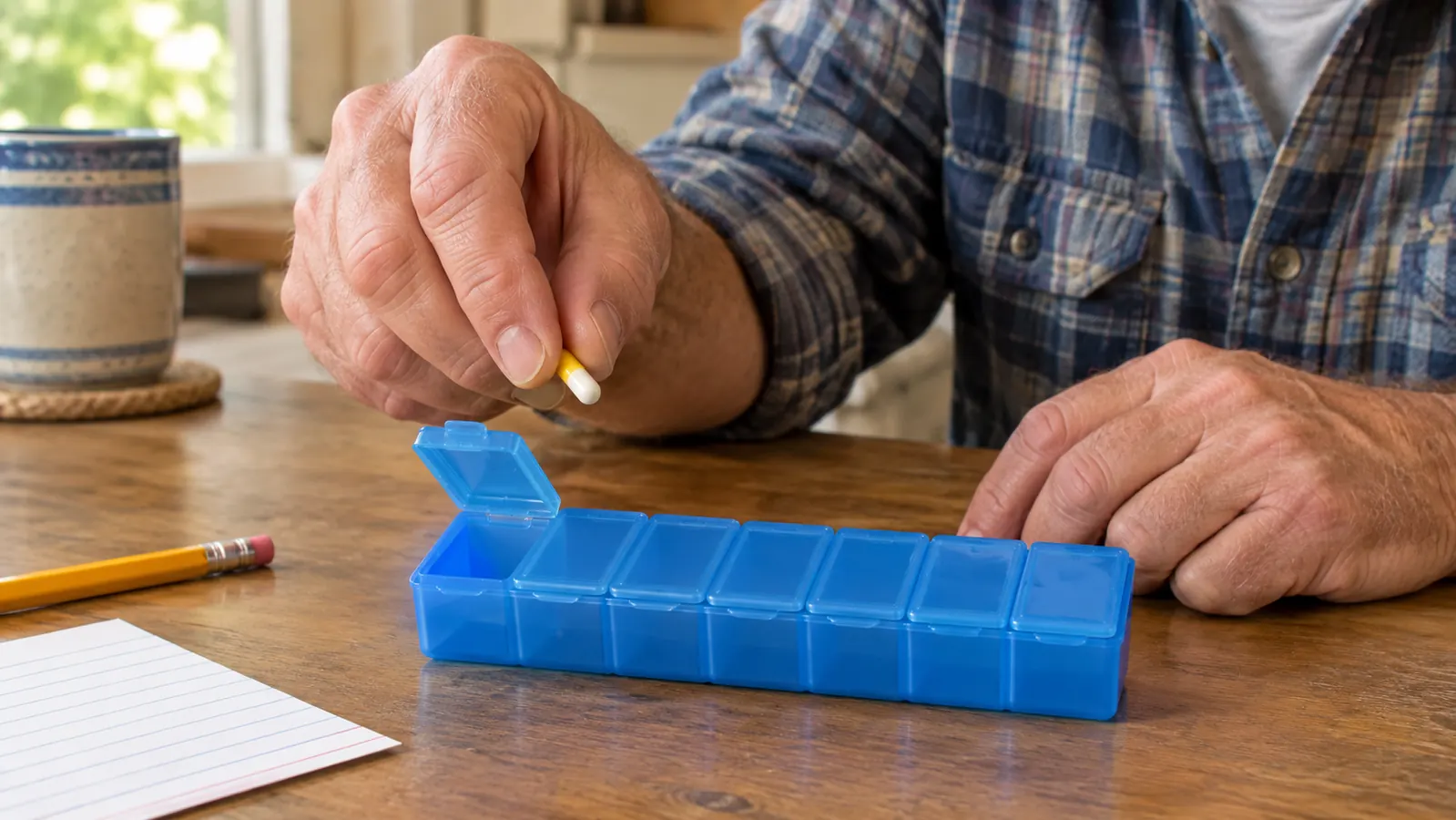
This is the step people skip, and it is the only one that decides whether the jar empties or sits there going dusty. I do not take vitamin C at a special time. I take it at breakfast, around 8am, because breakfast is the one thing I do every day without being reminded. The capsule goes into the AM lid of my blue plastic seven day pill box, which I fill on Sunday evening at the kitchen table with the index card propped against the salt shaker.
The pill box is not a product I bought for this. It is a blue plastic thing with AM and PM lids and no brand on it, and it does more for my consistency than any claim printed on a label. If you take one capsule a day, you hardly need a box. I need mine because there are five things on my card, and the box is how I know at 4pm that I did not double up at 8.
The last piece of the routine is water. I keep a glass by the sink and I take the capsule with a full glass, standing up, before I sit down with the newspaper. That is the whole ritual. No timing tricks, no cycling, no scheduling around anything beyond the breakfast I was going to eat anyway.
Step 5: Write it on the card and take the card to your doctor or pharmacist
I take five things. That is not a recommendation, it is a fact about my kitchen cabinet, and it matters here because vitamin C is already in my multivitamin. I found that with a pencil, comparing two labels at the table, and it was the most useful thing I did all year. When I spotted the overlap I wrote both amounts on the card and took the card to my doctor at my yearly physical. She looked it over and said it was fine for me. For me. She also said that was a decision for me and not a rule for my neighbor.
This is the part where I am careful. I am not a doctor and I am not a nutritionist, and nothing in my kitchen is medical advice. If you take a prescription, if you are pregnant, if you have a health condition, or if you are already getting vitamin C from another bottle, ask your own doctor or the pharmacist at your grocery store before you add a 1000 mg capsule to your morning. Mine is a man who has answered the same three questions from me for years without sighing once, and he is free.
The card does something quieter, too. It lets you stop re-deciding. Every few months I set the card next to the labels and check that nothing has changed. That is the entire system, it costs one index card, and it took me about ten minutes to set up.
What I can judge is the label, the size of the capsule, and whether the jar is still in the cabinet in February. I cannot tell you I feel a difference, and I would not trust anyone who says they can.
What Else Helps
Two smaller things. First, do not buy two bottles of the same vitamin. When I was deciding, I stood in the aisle with a chewable in one hand and the Sports Research jar in the other and read both labels. The chewable listed sugar and flavoring, and a chewable does not sit neatly in a pill box, so it was out for me. I have never taken a chewable vitamin C, so I am not going to tell you anything about what it does. I simply knew I would not keep up with it. The comparison was decided on convenience, not on anything a label promised.
Second, give it a month before you decide anything at all. A jar of 240 capsules is not going anywhere. Buy one, put it where your morning already happens, and at the end of four weeks look at whether the jar has moved. That tells you more than any review, including mine. The listing's 4.8 stars and more than 10,000 ratings are other people's mornings. They are not yours, and neither is my index card.
The label you can finish reading is the one you will still be taking in February
Sports Research High Potency Vitamin C, 1000 mg in a veggie capsule, 240 to a jar, one capsule up to three times daily with or without food. Ask your own doctor or pharmacist how it fits with everything else you take, then put the jar where your breakfast already is.
Amazon Check Today's Price on Amazon →